Here are several key events from 2025 that illustrate how Ivanishvili’s Georgian Dream systematically undermined democracy in Georgia, consolidated authoritarian rule, and pushed the country closer to Russia.
Although Ivanishvili’s government now prohibits even standing on the sidewalk—threatening imprisonment for those who defy the ban—pro-European protesters have persisted in the streets for over a year.
- Mzia Amaglobeli’s Case: “Fight Before It’s Too Late”
“Fight Before it’s too late”—the words of journalist Mzia Amaglobeli, who is unlawfully imprisoned—have become a rallying cry. Her case now symbolizes Georgia’s fight for a European future.
On December 16, 2025, the European Parliament awarded Mzia Amaglobeli the Sakharov Prize—the EU’s highest human rights honor. She is the first Georgian citizen to receive this distinction.
The 2025 Sakharov Prize was awarded to two imprisoned journalists: Georgian Mzia Amaglobeli and Belarusian Andrzej Poczobut.
“I accept this award on behalf of all political prisoners unjustly serving sentences for fighting for Georgia’s European future. This award shows that our voice—the voice of Georgia’s citizens—is heard in Europe. My people have come a long way for this to happen, as Russia has always stood in our path,” Mzia Amaglobeli wrote in a letter to Members of the European Parliament.
Read Mzia Amaglobeli’s full letter.

The award was received on behalf of Mzia Amaglobeli by Batumelebi journalist Irma Dimitradze, and on behalf of Andrzej Poczobut by his daughter.
Mzia Amaglobeli is the co-founder and director of the publications Batumelebi and Netgazeti. January 12, 2026, will mark one year since her unlawful imprisonment.
The Case of Mzia Amaglobeli Reveals How the Ivanishvili Regime Targets Individuals
On January 12, 2025, Mzia Amaglobeli was arrested on charges of assaulting a police officer after slapping Batumi Police Chief Irakli Dgebuadze. During her arrest, Dgebuadze insulted and threatened her. Earlier, the Adjara police chief had unlawfully detained her for posting a sticker on a police fence. The case against Amaglobeli was fabricated, as confirmed by false police testimonies—senior officials were exposed in court by her lawyers for lying.
After her arrest, Dgebuadze spat in Amaglobeli’s face and denied her access to water and toilets. These acts of inhumane treatment and violence were never investigated by the Georgian Dream prosecutor’s office. Moreover, the investigator never once questioned Amaglobeli while she was in detention.
- Chemical Weapons Allegations: Georgian Dream Rushes Probe, Tries to Bury the Story
On December 1, 2025, the BBC published an explosive investigation revealing evidence that the Georgian Dream government likely deployed chemical weapons—dating back to World War I—against anti-government protesters in 2024.
The ruling party swiftly threatened legal action against the BBC, yet months later, no lawsuit has been filed against the respected British media outlet.
In the wake of the documentary, the State Security Service of Georgian Dream launched an investigation—wrapping it up in just five days. Their conclusion: the substance deployed by the Ministry of Internal Affairs during the dispersal of pro-European protests on December 4–5, 2024, was chlorobenzylidene malononitrile—commonly known as tear gas.
“Our legislation does not allow the mixing of any substance into a water cannon,” noted Nona Kurdovanidze, chairperson of the Georgian Young Lawyers’ Association (GYLA). Human rights advocates say that senior officials in the Georgian Dream government cannot escape accountability before international courts, since these actions constitute crimes against humanity.

Water cannon used against peaceful protesters in front of the Parliament building in Tbilisi.
- Elene Khoshtaria’s Case: Imprisoned Over a Banner
Elene Khoshtaria is the only female political leader currently behind bars. The Georgian Dream prosecutor’s office accuses her of damaging property.
Her so-called offense is writing “Russian Dream” on a pre-election banner for Kakha Kaladze. Prosecutors allege her inscription resulted in 570 GEL in damages.
Khoshtaria was arrested on September 15, 2025. Refusing to pay bail, she has boycotted court appearances in protest.
The banner that landed opposition leader Elene Khoshtaria in prison—a case her lawyers argue is a clear-cut violation of freedom of expression.

The banner with the inscription that led to the opposition leader’s imprisonment. Lawyers argue the writing is protected by the right to freedom of expression.
Khoshtaria’s act was one of solidarity. Just days earlier, on September 12, Batumi student Megi Diasamidze was arrested for the same “Russian Dream” inscription on Kaladze’s banner. Diasamidze was released on bail, but her trial continues and she faces up to five years in prison.
The case of Elene Khoshtaria epitomizes Georgian Dream’s efforts to clear the political arena of opposition—often without legal grounds. It’s another example of the party’s systematic assault on constitutionally protected freedom of expression.
- Georgian Dream Seeks to Ban Opposition Parties — Case Assigned to Judge Who Once Was a Prosecutor of UNM Government
After jailing opposition leaders, Bidzina Ivanishvili’s Georgian Dream is now moving toward the outright banning of rival political parties.
On November 4, 2025, Georgian Dream petitioned the Constitutional Court to ban three coalitions: United National Movement (UNM), Lelo, and For Changes.
According to the ruling party, the constitutional complaint is based on findings from the Tsulukiani Commission and alleges violations under the Georgian Constitution, including: overthrowing and violently altering the constitutional order, undermining Georgia’s independence, and violating the country’s territorial integrity.
One notable detail: the judge assigned to review the case to ban opposition parties is a former prosecutor who served under UNM’s government.

Vasil Roinishvili — Judge reviewing the ban on the UNM; during Saakashvili’s presidency, he served as a prosecutor for the UNM.
Vasil Roinishvili was the Chief Prosecutor of Adjara when UNM was in power, and Sergeant Roin Shavadze was killed in Batumi. In 2020, the European Court of Human Rights ruled that the state had violated the right to life guaranteed under the European Convention in the Roin Shavadze case. Roinishvili, the prosecutor in that case, was questioned in September 2023. Since 2020, he has served as a judge on the Constitutional Court and is among the senior officials who should have been held accountable for the brutal, group murder of the sergeant. Instead of facing accountability, Roinishvili was promoted.
In its petition, Georgian Dream seeks to ban the UNM, citing the Roin Shavadze case. This means the judge now reviewing the opposition ban—Vasil Roinishvili—was chief prosecutor at the time of Shavadze’s murder.
- Opposition Leaders Imprisoned for Failing to Appear Before the Tsulukiani Commission
The goal of the so-called Tsulukiani Commission is clear, even at first glance: the elimination of opposition political parties. However, political analysts note that the commission may have a hidden agenda aligned with Russia’s interests—namely, framing Georgia as responsible for the 2008 war and preparing the ground for the recognition of Abkhazia and South Ossetia.
Failure to appear before the Tsulukiani Commission became one of the main pretexts used by the Georgian Dream regime to imprison large numbers of political opponents. The prosecutor’s office detained opposition leaders under Article 349 of the Criminal Code, which concerns failure to comply with a temporary investigative commission of the Georgian Parliament.
According to the Georgian Young Lawyers’ Association (GYLA), failing to appear before the Tsulukiani Commission does not constitute a criminal offense.
Opposition leaders arrested included Nika Melia and Zurab Japaridze of the Coalition for Changes, as well as Irakli Okruashvili. Lelo party leaders Mamuka Khazaradze and Badri Japaridze were released on bail in April 2025 and, unlike other opposition figures, were able to participate in local elections. Also detained were Strategy Aghmashenebeli leaders Giorgi Vashadze and Givi Targamadze. Most were sentenced to seven to eight months in prison, but as their release dates neared, the Georgian Dream prosecutor’s office filed new charges against them.
On December 19, 2025, Zurab Japaridze left the detention facility. For the new charges related to sabotage, he was released on bail.
According to the respected NGO Transparency International Georgia, “This commission [referring to the Tsulukiani Commission] arbitrarily assumed powers not provided for in parliamentary regulations. On one hand, it severely damaged the country’s multi-party political system [by seeking to ban parties, imprison political leaders for failing to appear before the commission, etc.]. On the other hand, it adopted a collaborative stance on the 2008 Russia–Georgia war that would be applauded only by Russia’s highest political officials.”
- Georgian Emigrants Barred from Voting Abroad
On December 17, 2025, Georgian Dream approved a new version of the Electoral Code that restricts emigrants from participating in elections.
To guarantee victory in the elections, Ivanishvili’s Georgian Dream moved to entirely exclude emigrants from the process.
Post-2016 statistics reveal that Georgian Dream consistently struggled to manipulate votes among emigrants. In 2020, the party received just 29.03% of the vote at overseas polling stations (compared to 48.22% nationally), and in 2024 only 13.49% (compared to 53.93% nationally).
Under the new amendments, Georgian citizens living abroad who previously could vote at polling stations overseas now lose this right. To participate in elections, they must return to Georgia.
The decision by the Georgian Dream-led parliament also severely worsened the electoral environment. Changes to the composition of the Central Election Commission and new restrictions on photographing or filming during voting now effectively deny the right to monitor elections.
Before Georgian Dream could all but nullify elections in the country, voter turnout hit a record low—the lowest in Georgia’s electoral history.
On election day, October 4, a large protest took place in Tbilisi. Some demonstrators attempted to breach the Presidential Administration building’s courtyard. Special forces responded with water cannons, pepper spray, and tear gas. Forty-six people were arrested in connection with the October 4 case, including members of the protest’s organizing committee: Paata Burchuladze, Murtaz Zodelava, Irakli Nadiradze, Paata Manjgaladze, and Lasha Beridze. They face up to nine years in prison.
The prosecutor’s office has not investigated whether the Georgian Dream government provoked the incident—for example, by having the Presidential Palace’s fence cut before protesters arrived.

Following the October 4 protest, Zurab Chavchanidze, a flag bearer from Batumi, was also arrested. The prosecutor’s office accuses him of attempting to seize a strategically important facility—the Presidential Palace—and participating in group violence.
- Imprisonment for Protesting on the Sidewalk
In its ongoing crackdown on dissent, the Georgian Dream regime has gone so far as to criminalize protest expressed simply by standing on the sidewalk.
In 2026, twenty-three citizens face imprisonment for participating in sidewalk protests. They are accused of obstructing passersby on Rustaveli Avenue in Tbilisi, and under repressive regulations enacted in December 2025, could be detained for up to 15 days.
If they return to the sidewalk, they could face criminal prosecution and longer imprisonment.
The legislative changes introduced a new tactic to restrict protest: artificially blocking the road. Judges and the Ministry of Internal Affairs warned citizens detained under this pretext, asking, “Why couldn’t you protest on the sidewalk?” before sentencing them to up to 15 days in detention.
On December 12, 2025, further amendments made standing on the sidewalk itself a punishable offense. The law expanded the definition of “artificially blocking the roadway” to include “artificially blocking the pedestrian walkway.”

Student Megi Diasamidze, a participant in sidewalk protests
Over the course of a single year, the Georgian Dream-led parliament amended the Law on Assemblies and Demonstrations and the Administrative Offenses Code five times. The process began by tripling fines and culminated in the introduction of imprisonment.
The party even criminalized the wearing of face masks during protests.
At the same time, Georgian Dream removed constitutional protections that guaranteed freedom of speech and expression. For example, the burden of proof was shifted from the plaintiff to the defendant, and journalists could now be held liable simply for refusing to reveal a source.
- Critical Television Channel Mtavari Arkhi Shut Down
The anti-constitutional government of Georgian Dream is aggressively targeting critical media. Through legal acts, troll and bot factories, hostile rhetoric, incitement to violence, and uninvestigated attacks on journalists, the party’s objective is clear: critical media must not exist in Georgia.
One of the main critical television channels, Mtavari Arkhi, has already been shut down. On May 1, 2025, its broadcasting stopped. Since February 15, the channel had suspended all live programs because it no longer had the financial means to operate daily. According to Mtavari Arkhi, Zaza Okuashvili, the channel’s co-founder, deliberately created a financial crisis for the channel.
Georgian Dream passed restrictive media legislation that effectively abolished the broadcasting self-regulation mechanism and prohibited broadcasters from receiving direct or indirect foreign funding, including equipment transfers, training programs, media development projects, and other forms of support.
Amendments to the Law on Grants entirely blocked online media from receiving funding from foreign foundations, which had previously been their primary source of revenue.
- Under Georgian Dream, Even Solidarity Is a Crime
The resistance movement in Georgia has shown an unusual example of solidarity. Citizens who were fined for blocking roads or for wearing face masks had their fines paid collectively by people across the country.
Georgian Dream seized these solidarity funds. Criminal investigations are now targeting citizens simply for helping one another and standing together.
Recently, the ruling Georgian Dream party has used various legal tactics to repress protest participants and create obstacles for them. Ivanishvili’s government not only attempts to suppress protests through brute police force—a strategy that has so far failed—but also effectively criminalizes assistance to protest participants and their efforts to protect themselves from violence.
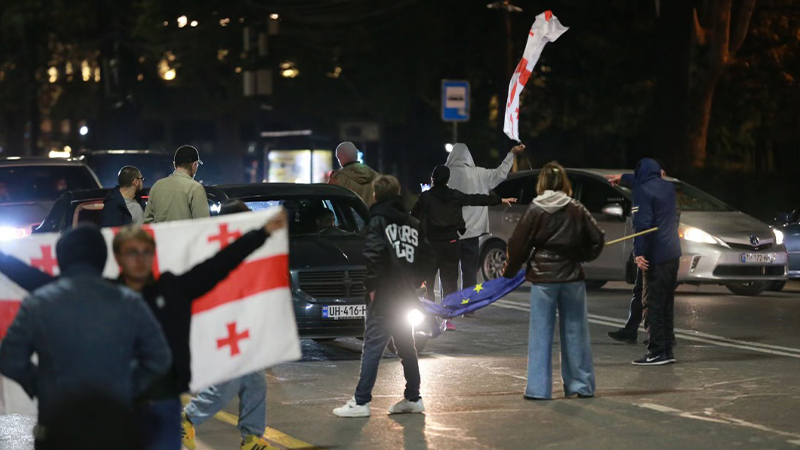
Tbilisi protest
A clear example is the repressive criminal measures the government has taken in recent months against citizens’ assistance funds—commonly referred to in society as ‘solidarity funds.’ These measures have nothing to do with law or maintaining public order. Their goal is to eliminate any form of protest, regardless of whether it is peaceful and constitutional, and to suppress the willingness of citizens to show solidarity and mutual support through the abusive use of criminal proceedings,” notes Transparency International Georgia in its analytical report, “How Helping People Is Punished in Georgia.”
To prevent solidarity from spreading, Georgian Dream amended several laws. For example, changes to the Law on Grants restrict Georgian NGOs from providing assistance to citizens. Their activities have become practically impossible: international organizations can no longer issue grants without the prior approval of the Georgian Dream government.
- Total Control Over Public Servants — Another Step Toward Authoritarianism
Another amendment was introduced to the Law on Public Service. In April 2025, the legal status of public servants deteriorated further.
After Georgian Dream’s Prime Minister, Irakli Kobakhidze, halted the Euro-integration process, large-scale protests erupted, and some public servants joined the demonstrations.
Under the new amendments, mid-level officials—current heads of departments and services and their deputies—are considered employees under administrative contracts. The agency’s head can dismiss them at any time for any reason.
“No matter how much they try to hide this protest, the protest cannot hide itself. The longer they endure all of this, the more deeply it will destroy them personally,” said former public servant Salome Macharashvili in an interview with Batumelebi in November 2025. She is one of hundreds of public servants dismissed for participating in protests.
According to the Independent Trade Union of Public Servants “Article 78 of the Constitution”, between 800 and 1,200 public servants were dismissed for pro-European protest activity. Approximately 20% of those dismissed were able to find employment in the private sector.

Tbilisi Protest
- Recording Banned in Courtrooms
On October 2, 2025, a video recording by former Supreme Court judge Besarion Alavidze was made public. In the video, the ex-judge speaks about several high-profile cases, including the Rustavi 2 case and a dispute between the Joseph Kay and Patarkatsishvili family over a metallurgical plant. Alavidze revealed that because of these and other cases, he attempted suicide, was locked in an office with other judges, and was forced to undergo an unnecessary surgical procedure.
Judge Alavidze also stated that representatives of the Georgian Dream government offered him bribes—such as in the Rustavi 2 case—and issued threats.
This incident, like many others, remains uninvestigated.
Meanwhile, courtrooms have been entirely closed off to the media and the public. After police were repeatedly caught lying in open hearings, Ivanishvili decided to shut the courts completely. Journalists present in courtrooms are now prohibited from taking photographs, recording video, or making audio recordings.
Access to court decisions has also been restricted. Court documents will only be made publicly available after a final decision has entered into legal force, meaning that until all appeals have been exhausted, the public cannot access the decisions.
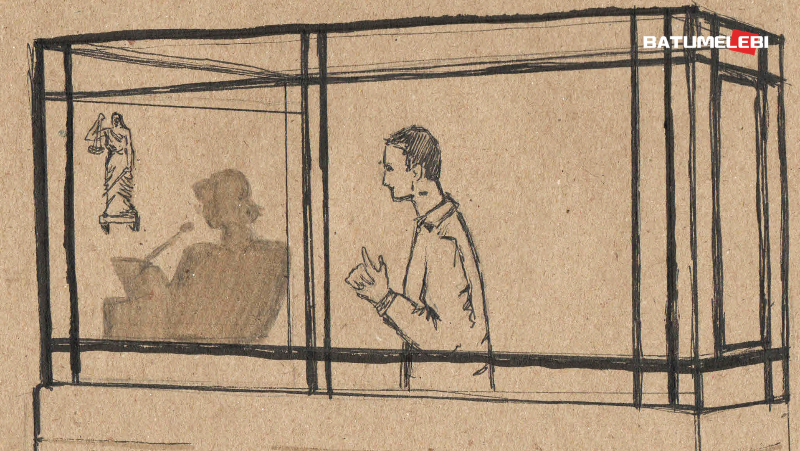
Mzia Amaglobeli’s closing hearing. Illustration: Ia Frangishvili/Batumelebi
- The National Security Council Abolished — What Else Did Georgian Dream Eliminate in 2025 to Move Closer to Russia?
The anti-constitutional parliament passed numerous other decisions that directly endanger Georgia’s statehood and sovereignty—issues the Georgian Dream government frequently references.
For example, the party’s parliament abolished the National Security Council. Ivanishvili’s Georgian Dream decided that the powers of the National Security Council would now be exercised solely by the government.
Previously, the crisis management room operated under a British model, enabling multiple agencies to coordinate effectively in emergency situations.
The Special Investigative Service was also abolished. This agency was responsible for investigating crimes committed by law enforcement, including torture and ill-treatment, offenses against journalists, and related abuses.
Additionally, the Personal Data Protection Service, established years ago to align with EU legislation, was eliminated, as were the Intelligence Service, the Anti-Corruption Bureau, the Parliament’s Gender Equality Council, and the NATO and EU Information Center, among others.
- Georgian Dream’s Long-Term Insurance on the Path to Dictatorship — Education Reform
The ruling party faced sharp criticism for another major decision: an education reform that experts called a “deformation.” The process, critics say, is designed both to distance Georgia from the European educational space and to neutralize universities and professors critical of the Georgian Dream regime—isolating them or forcing them into silence.
“Students from low-income families will struggle to enter universities,” said education expert Lela Chakhaia, highlighting the social impact of the reform.
At the same time, throughout 2025, Ivanishvili’s government and its propaganda media outlets intensified anti-Western campaigns.
Georgian Dream is increasingly closing Georgia’s door to the European Union every day.
In its October 30, 2025, report on Georgia, the European Commission stated:
If Georgia does not change its current course, which endangers its path to the European Union, and does not show tangible efforts to resolve pending issues and implement key reforms, it will not be possible to consider recommending the start of negotiations with Georgia.




![რას [არ] აკეთებს მერია ბათუმში უსახლკაროებისთვის – ინტერვიუ](https://batumelebi.netgazeti.ge/wp-content/uploads/2026/10/covers-batumelebi-3-1.png "რას [არ] აკეთებს მერია ბათუმში უსახლკაროებისთვის – ინტერვიუ")