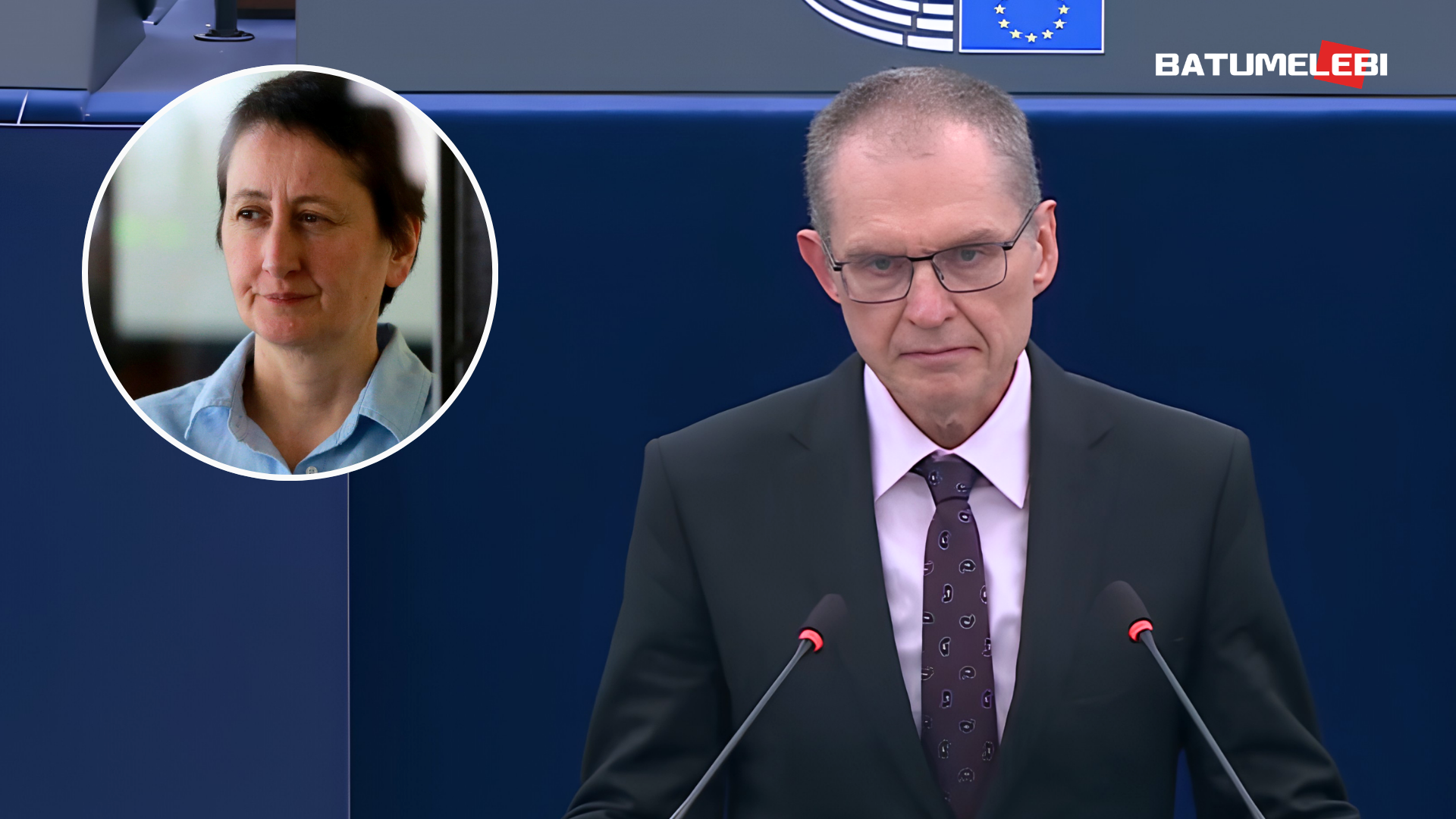
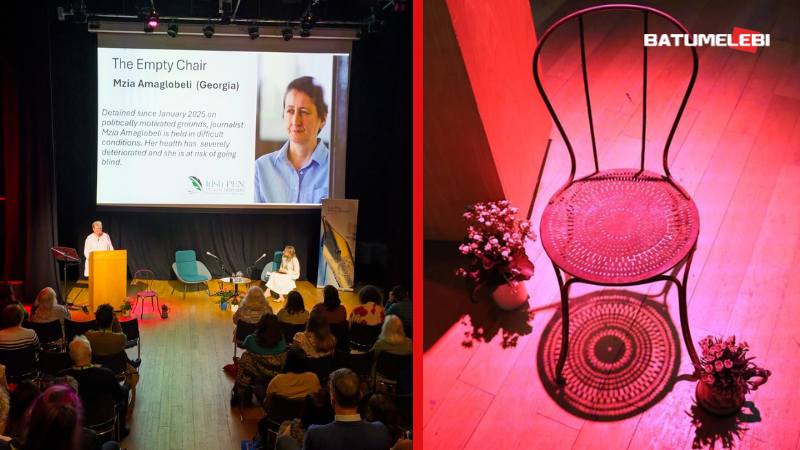
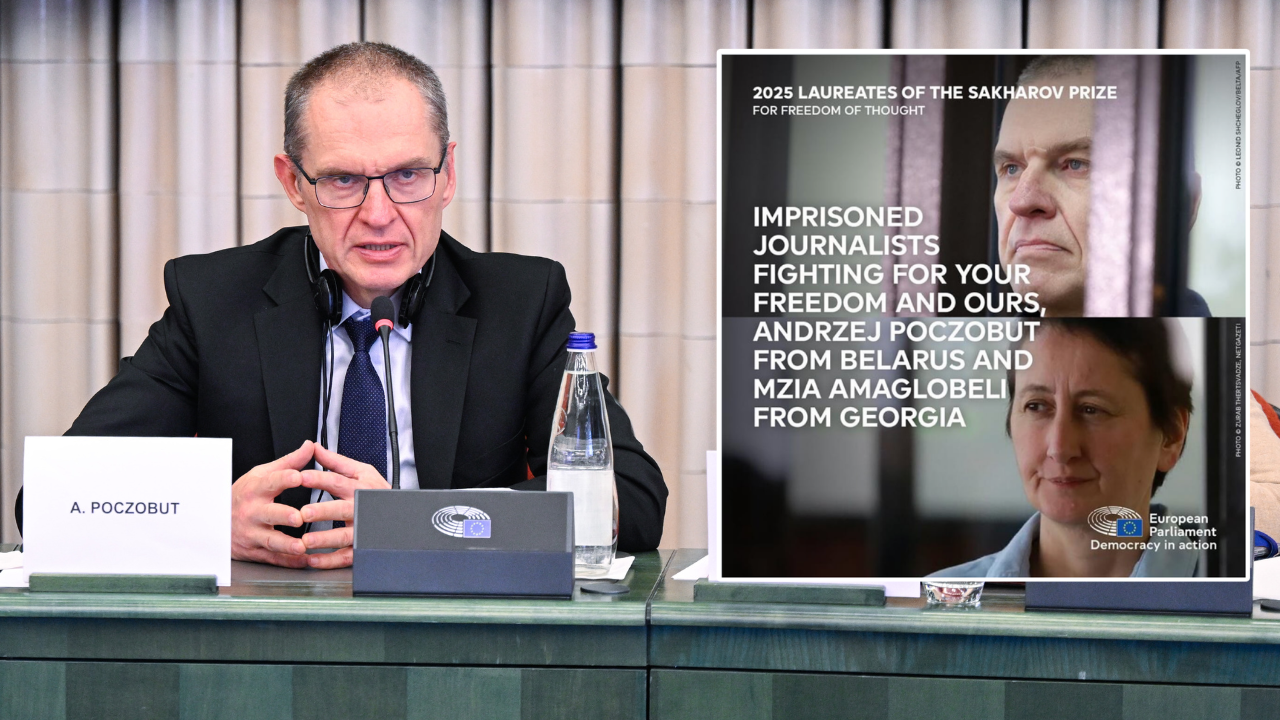
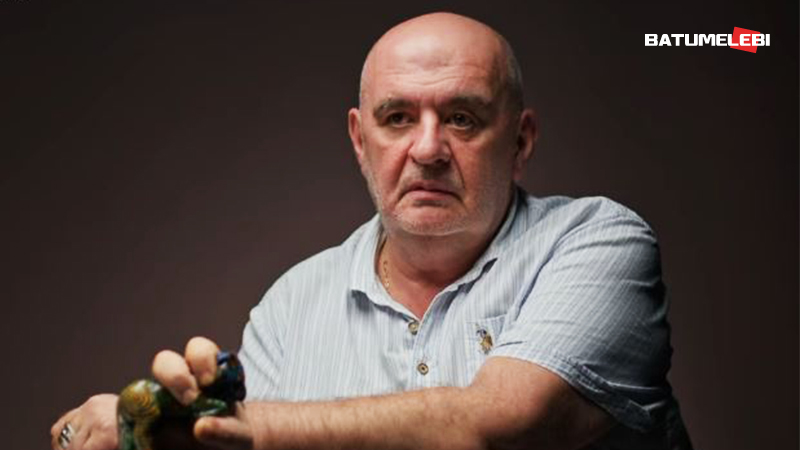
On December 16, Mzia Amaglobeli was awarded the European Union’s highest human rights honor, the Sakharov Prize, in Strasbourg. She received this prestigious award jointly with Belarusian journalist Andrzej Poczobut, who is also imprisoned.
The award was accepted on her behalf by Irma Dimitradze, a journalist from Batumelebi, who also read a letter from Mzia Amaglobeli, from prison, to the Members of the European Parliament.
Dear Members of the European Parliament,
Receiving the highest human rights award from you is a great honor and a great responsibility, and I accept it on behalf of my colleagues. These journalists are now fighting in Georgia to save journalism as such. They work tirelessly to ensure that you hear the voice of resistance from Georgia’s citizens and that the truth is not silenced.
I accept this award on behalf of all political prisoners who are unjustly imprisoned and “convicted for” fighting for Georgia’s European future.
This award is proof that our voice — the voice of Georgia’s citizens — is well heard in the European Union.
My people have walked a very long and difficult road for that voice to reach you, because Russia was always standing between us.
My generation knows well what kind of threat Russia is; we do not need to turn to historical sources for evidence. We have seen it with our own eyes and remember the years of Soviet occupation; we remember Georgians brutally beaten with shovels and poisoned with chemicals by the Russian troops; we remember the August 2008 war, and we live through the continued occupation of Georgia.
In the given circumstances, under constant Russian threat, building democracy was not easy, but we did our best.
We witnessed our votes having an impact on the elections, reshaped the environment to eradicate corruption in the higher education system, developed high-quality journalism and impartial media, debated the protection of human rights, the obligations of the state, and the responsibility of the citizens.
During these years, a new generation of Georgians learned English and other European languages rather than Russian. We aspired for the world to stop seeing us through the Russian lens. Europe came to know contemporary Georgian writers, artists, and film directors.
We exchanged knowledge, experience, and culture with you across the Black Sea.
We discovered interesting issues, friends, and even beloved cities across Europe.
Today, in my home country, the aspiration toward the European Union is being met with repression. The state has been captured by a regime that serves Russian interests. For more than a year, Georgian citizens have been continuously protesting in the streets against the announcement suspending the EU accession process. That announcement was like an ember — it sparked a fire that has been burning in Georgia ever since.
This regime is ruthless: it beats, fines, arrests, and blackmails protesters. It destroys free journalism, abolishes opposition political parties and imprisons their leaders, effectively dismantles non-governmental organizations, labels those who work in them as “foreign agents”, and — as we recently learned from a BBC investigative documentary — allegedly poisons citizens using toxic chemical substances. The allegation that requires an international investigation.
Yet it has failed to silence the protests. Perhaps this is why the European Union’s statements in support of the Georgian people have been stronger and more precise than ever. And for this, I am deeply grateful.
I also wish that these statements would turn into action and that European leaders would use all available mechanisms to exert pressure on autocratic rulers. It is my wish that you stand for Georgian society — its democracy and its European aspirations — as you stand for the freedom of your own countries. Because in the end, it all comes down to this: it must now be unmistakably clear that the force behind the horrors in Belarus, Ukraine, and Georgia is moving closer to the heart of Europe. It is heading toward your homes — and we are merely in its way.
Soon, much of the European world will celebrate Christmas and the New Year. In recent days, I have been thinking about how the leaders of the EU and member states, the US, the UK, and other democratic states would congratulate the rest of the world. What will you tell them about the future? About a new world order and peace?
Will you say that the expansion of democratic governance and security is no longer a benefit to humanity? Will you say that we must accept the “illusory peace” and “borders” offered by autocratic and dictatorial forces?
Will you say that economic influence takes precedence over the partnerships based on equality, solidarity, and trust? That international law and institutions have lost their power and are incapable of acting, while repressive regimes terrorize citizens fighting for freedom, democracy, justice, and dignity by imprisoning them or forcing them into exile?
We remain here, in Georgia, on the streets of our cities, where even holding peaceful protests is now banned; we stay in prisons, where we have been unlawfully confined. And while we keep up our fight, we look forward to you.
And as someone who knows Russian threats very well, we’re here to tell you that if the civilized world allows Moscow to unilaterally impose the so-called “peace agreements” and redraw borders according to its imperial ambitions, this will clearly be an announcement of endless wars on this beautiful continent.
If freedom-loving nations like Georgia, and brave warrior, independent states like Ukraine, are left alone in the face of Russia’s hybrid warfare or military aggression, it will be an irreparable historical mistake for which you and us will have to pay a heavy price.
The fate of our struggle does not depend on us alone, because our struggle is not only about us. We need your solidarity and support — the solidarity of the people of Europe and of free individuals across the civilized world.
Fight with us and for us. Fight as you would fight for the freedom of your own countries. Use every mechanism at your disposal and do so before it is too late.
I believe this is possible. I believe in a free, democratic, and strong Europe!
Thank you!
Mzia.