“It is my honor to represent Ms. Mzia Amaglobeli in this trial,” stated Mzia Amaglobeli’s attorney, Maia Mtsariashvili, on August 1st in Batumi City Court. Before presenting the legal arguments of the defense, she began by explaining to the court who Mzia Amaglobeli is and what her work entails.
Batumelebi presents a slightly abridged transcript of attorney Maia Mtsariashvili’s statement in court.
“Mzia Amaglobeli’s life and professional work are directly linked to the publications she founded: Batumelebi and Netgazeti.
For the past 24 years, she has worked tirelessly every day to implement various projects aimed at strengthening media, education, and promote social justice in Georgia.
It all began 24 years ago, in 2001, when a young, enthusiastic journalist, Mzia Amaglobeli, together with Eter Turadze — who testified as a witness in this trial — founded a newspaper in Batumi, the Gazeti Batumelebi.
Batumelebi is exactly 10 years younger than independent Georgia, but they share the same birthday — May 26 — which I believe is no coincidence. In 1991, Georgia declared independence based on the May 26, 1918, Act of Independence. Ten years later, on May 26, 2001, the first issue of Batumelebi was published.
From today’s perspective, this was not a random coincidence. It was Mzia’s bold declaration that Batumelebi would be an independent newspaper in an independent country, with the primary goal of promoting free speech and supporting democracy.
During Aslan Abashidze’s rule in Adjara, all state institutions were fully controlled by him and his party, the Revival Union. At the same time, human rights violations were widespread, opposition parties and dissenters were persecuted, and separatist sentiments were actively encouraged.
The editorial office of Batumelebi began operating in a small room, with just one computer and Mzia’s unwavering belief in freedom. Imagine — this was 2001, Mzia was 26 years old at the time. Today she is 50 — and tragically, she turned 50 in prison.
Over the years, Mzia worked at Batumelebi as a journalist, focusing on human rights coverage. As the outlet developed and grew stronger, she transitioned to media management and became director, while bringing together a team of young journalists dedicated to their profession — many of whom I came to know personally.
At the dawn of Batumelebi, under Abashidze’s regime, operating an independent media outlet in Adjara posed significant risks, including the threat of physical assault. Unsurprisingly, Batumelebi quickly became a target of the local authorities for its unrelenting exposure of corruption, nepotism, and human rights abuses.
There were multiple instances of threats, pressure, and even physical attacks.
For example, Batumelebi published a report exposing how the local police were protecting and facilitating prostitution in Batumi. This report led to a physical attack on Mzia. That’s what she meant when she stated in this courtroom that she knows exactly what it means to be attacked.
After Abashidze left Georgia, the newspaper began developing even more rapidly. Its circulation grew, page count increased, but its editorial policy remained unchanged. Even under the new government, Batumelebi maintained its independence and critical stance.
In 2010, Mzia Amaglobeli, along with like-minded individuals, founded the online publication Netgazeti in Tbilisi. This was a rare example of a regional outlet growing strong enough to establish a new media organization in the capital.
I don’t want to focus only on Mzia’s journalism — I want to draw the court’s attention to her other work, starting with the professional recognition of the outlets she founded.
Batumelebi and Netgazeti, as well as their journalists, have received numerous awards for their professional work. Mzia’s role in these achievements is substantial.
Let me name just a few:
- In 2008, Batumelebi received the Press Prize from the Norwegian Fritt Ord Foundation and Germany’s Zeit-Stiftung;
- In 2009, Batumelebi was awarded the Press Freedom Award – Signal for Europe by Reporters Without Borders, in recognition of their reporting on the brutal killing of officer Roin Shavadze. These reports were later included in the case brought before the European Court of Human Rights.
While many so-called politicians today tirelessly criticize previous governments, Mzia was reporting on grave issues like this back in 2008.
In 2015, Netgazeti received yet another prize from the Fritt Ord Foundation and Zeit-Stiftung for being “fearless in the face of censorship and repression.”
Additionally, their journalists have received numerous awards from the Georgian Charter of Journalistic Ethics, the Public Defender of Georgia, the President of Georgia, the Dutch Embassy’s Human Rights Tulip award, and other local and international organizations’ awards for good journalism.
Please take note — In 2022, Russia’s federal communications regulator, Roskomnadzor, blocked the Russian-language versions of Netgazeti and Batumelebi, labeling them as “anti-Soviet propaganda distributors” and banning them in Russia.
Now I want to talk about Mzia’s work beyond journalism.
The projects implemented by Mzia over the years have created lasting social value, positively impacting the lives of dozens, hundreds, even thousands of people—especially vulnerable groups in Adjara and beyond: students, socially disadvantaged individuals, the elderly, those without access to education, victims of violence, eco-migrants, and more.
Let me highlight just a few of her initiatives:
As early as 2006, she began a crucial advocacy project to assess the conditions and needs of people resettled from Adjara to other regions of Georgia. A dedicated team visited almost every landslide-prone village in Adjara, as well as regions such as Kakheti, Samtskhe-Javakheti, Kvemo Kartli, and Imereti.
Through this project, the term “eco-migrant” was coined and later widely adopted.
Based on the findings, a draft law was prepared for the Supreme Council of Adjara and Parliament, and it became the catalyst for a government program to support eco-migrants, significantly improving the lives of many families.
In 2010, Mzia launched Press Café in Batumi — a free public discussion space for different societal, civic, and political groups that became known nationwide. Many of the people who are now government representatives in Adjara used the space on a regular basis. Over the period of four years, it hosted nearly 500 events, debates, film screenings, exhibitions, and charity events.
From 2004 to 2022, together with partner organizations, Mzia conducted multiple rounds of the educational project Media School, which introduced many students and schoolchildren to journalism — some of whom now work in major media outlets of Georgia
In 2021, she launched The Traveling Library to assist school libraries in mountainous Adjara, a project supported by the Embassy of Japan and Georgian publishers. It brought books worth 70,000 GEL to 29 mountainous villages in Adjara, updated 29 libraries, and hosted discussions with contemporary Georgian authors.
This project also helped debunk COVID-19 myths and promoted vaccination in hard-to-reach communities by organizing meetings with trusted medical professionals.
On March 8, 2019, Mzia organized a conference in Batumi on violence against women, with speakers including the then-prosecutor of Adjara and the head of Batumi City Court.
She also spearheaded a cultural heritage project documenting the history of Batumi and Adjara’s villages, which led to the publication of three books. One of them, Unknown Old Adjara, won the prestigious Saba award for best documentary prose.
In recent years, she launched a new project focused on Stalinist repressions in Georgia, aiming to study and reflect on this traumatic part of history.
Following Russia’s invasion of Ukraine, Mzia joined a campaign to support independent Ukrainian media, raising funds to help them survive wartime conditions.
She has also initiated and supported many charitable campaigns. Articles published by Batumelebi and Netgazeti have inspired fundraising efforts that changed human lives.
A few examples:
- In 2024, after an article about a woman living in poverty in Khulo, readers raised 97,000 GEL to support her;
- In 2021, readers raised over 55,000 GEL for two orphaned boys from “Dream Town” who had lost both parents;
- In 2021, after publishing a story and video about a young homeless man in Martvili dancing on the street to raise money for his mother’s surgery, readers donated 42,000 GEL—enough to fund the medical operation and buy him a home.
Mzia’s office is on the 4th floor of Batumelebi. Her colleagues tell me the lights in her room were almost never turned off — because she worked through the night for the well-being of this country and its citizens, for freedom of speech, for social justice, and for democracy.
I’ve tried to briefly summarize the work Mzia has done over the years. Though she is a quiet person, her work speaks loudly.
Your honor, Mr. Prosecutor, I invite you to get to know Mzia Amaglobeli. I am honored to represent her in this court.”
What You Need to Know
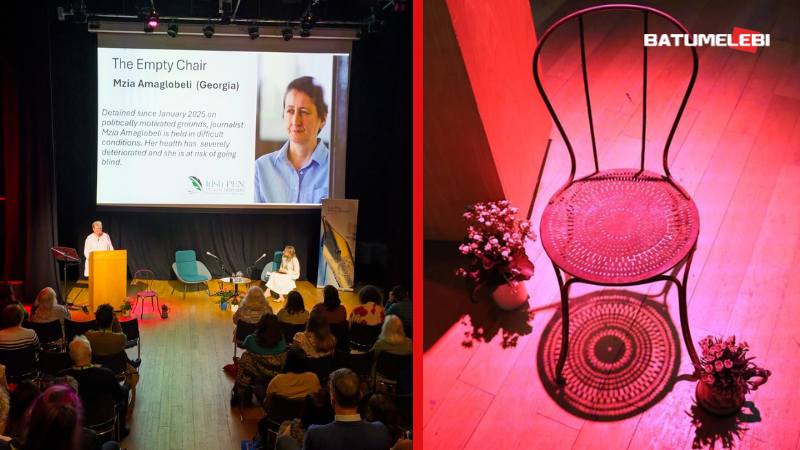
Mzia Amaglobeli is the co-founder and director of the media outlets Batumelebi and Netgazeti. She has been unlawfully imprisoned for almost seven months, with the prosecution accusing her of attacking a police officer after slapping one.
According to leading human rights defenders, the act of slapping, which caused no harm, does not constitute assault and is not a criminal offense at all. Even the Supreme Court has established that a slap does not qualify as an attack.
Leading global press freedom organizations have rallied around Mzia Amaglobeli’s case. Representatives from the Committee to Protect Journalists (CPJ), the International Press Institute (IPI), and Reporters Without Borders (RSF) visited the women’s prison colony in Rustavi on July 13 to show their solidarity with Mzia Amaglobeli. They also attended the court hearing in Batumi on July 14.
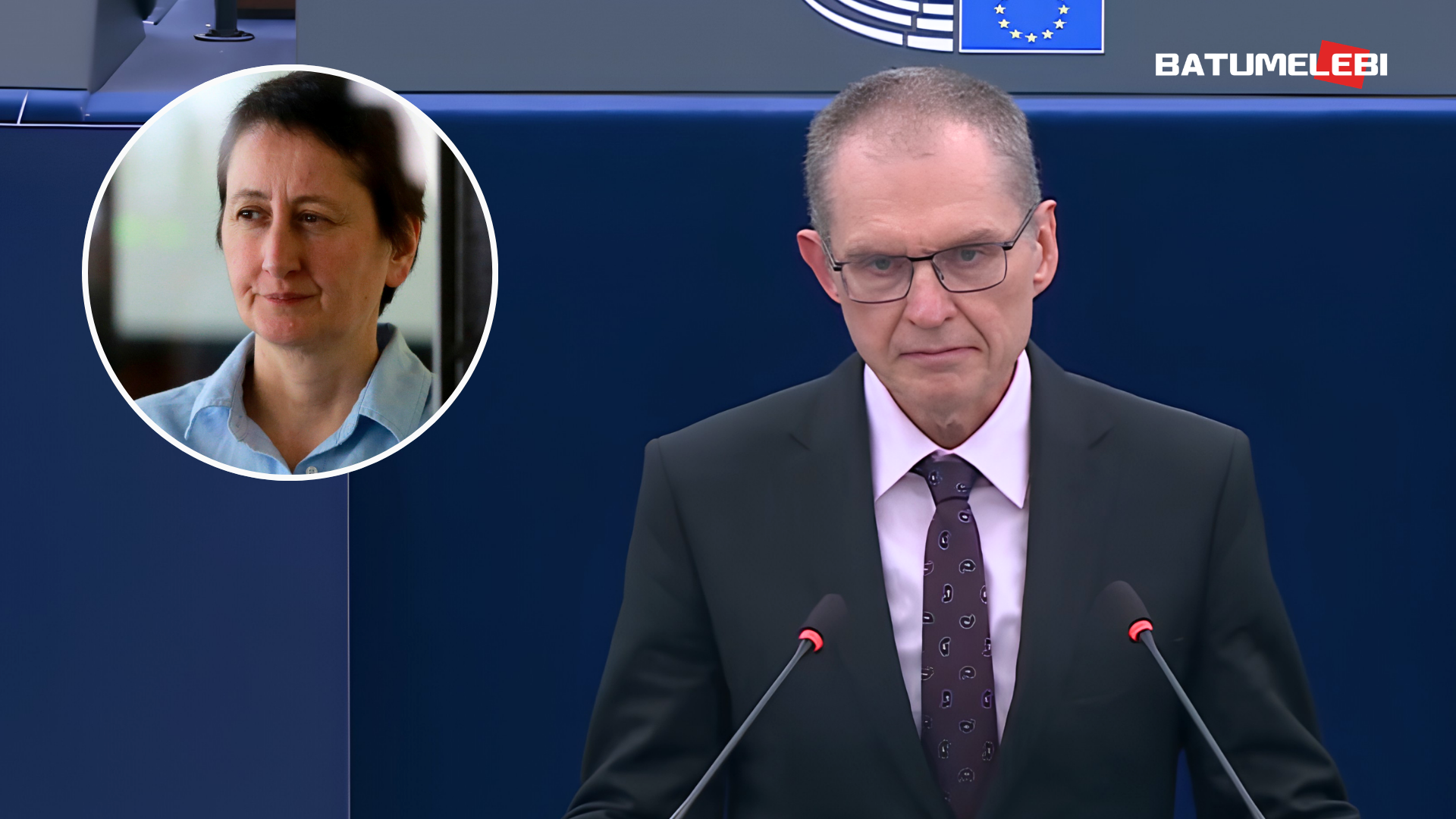
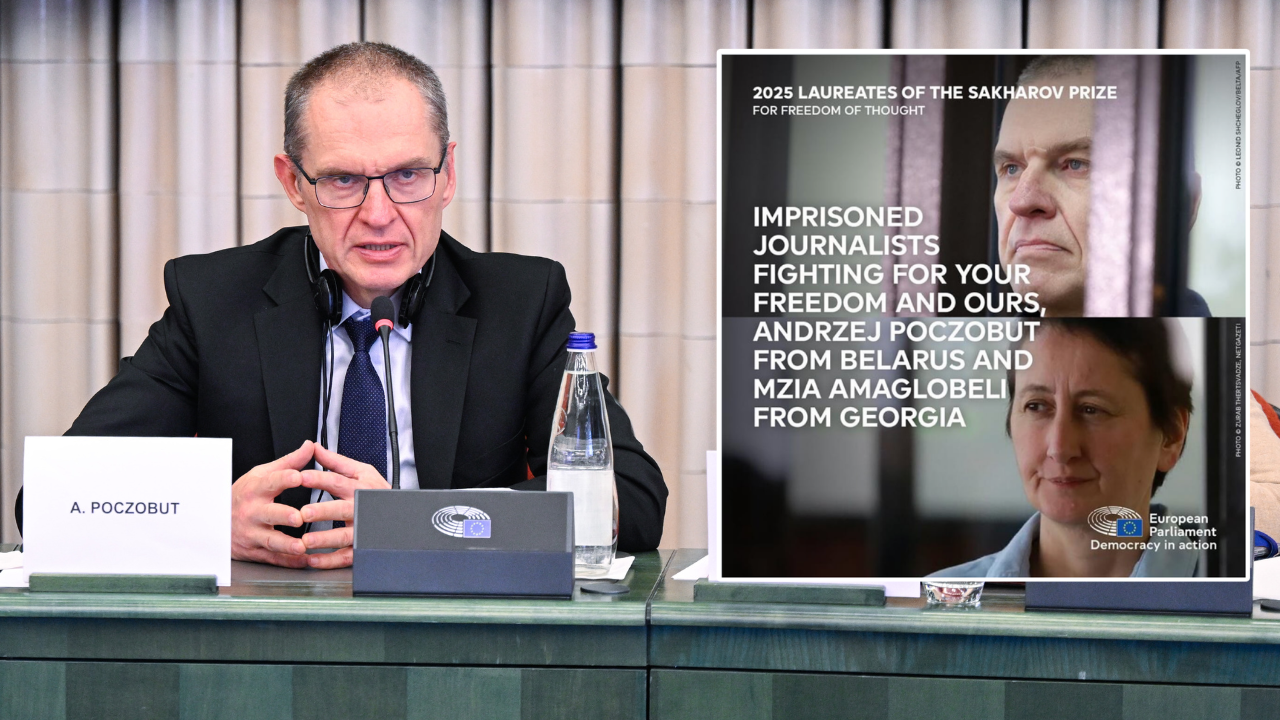
The European Parliament’s resolution includes a demand for the “immediate and unconditional release of Mzia Amaglobeli and the dropping of all politically motivated charges against her.” The resolution also expresses “deep concern over the critical deterioration of her vision while in custody” and calls for her immediate access to reliable medical care.
Mzia Amaglobeli’s case is currently under review by the European Court of Human Rights in Strasbourg.