“Mzia Amaglobeli’s vision has significantly worsened since she was placed in the penitentiary facility, reaching an alarming level.
Despite numerous requests, she has not received the medical examinations needed to plan her treatment.
To date, she has been unable to consult a doctor, which is essential for making informed decisions and organizing treatment to preserve her vision.” – The Georgian Young Lawyers’ Association (GYLA) is appealing to the Minister of Justice, urging that Mzia Amaglobeli undergo the required medical tests and receive appropriate treatment without delay.
GYLA has released Mzia Amaglobeli’s medical diagnosis and information about her prior treatment, demanding that she receive appropriate medical care.
- Mzia Amaglobeli’s Diagnosis
In 2013, Mzia Amaglobeli was diagnosed with keratoconus in her left eye. To slow the progression of the disease, she underwent surgery in Turkey that same year. Although her left eye’s vision remained at approximately 2%, her overall vision stabilized, primarily due to the functioning of her right eye.
Given her condition, Mzia Amaglobeli regularly underwent medical examinations every 3 to 6 months, as recommended by her doctors. By 2025, before her placement in a penitentiary facility, her right eye’s vision was about 30% (0.3), which could be corrected with glasses to 90%.
However, after her imprisonment, her vision deteriorated significantly.
According to examinations conducted on February 4, 2025, her right eye’s vision could be corrected with glasses to about 60%. A repeat assessment two days later revealed a rapid decline — her right eye’s visual acuity dropped to 0.1, indicating a 20% decrease within just two days. At this point, correction with glasses was possible only up to 40%, compared to the pre-incarceration potential of 90%.
- Examinations Conducted on Mzia Amaglobeli in Prison
According to information released by the Georgian Young Lawyers’ Association (GYLA), on July 1, 2025, Mzia Amaglobeli’s lawyer requested that she undergo advanced ophthalmological examinations at a suitable specialist clinic. The request suggested either the National Ophthalmology Center at New Hospitals or the Caucasus Medical Center.
Before her imprisonment, Mzia Amaglobeli had been receiving care at the National Ophthalmology Center, where her complete medical history is kept. Notably, the request specified that she would cover the cost of these examinations herself, meaning the state would incur no additional expenses.
To accurately assess the progression of her condition, it is essential to compare her previous and current examinations, particularly the topographic measurements. The progression of keratoconus cannot be determined solely by a decline in visual acuity, as decreased vision may be due to factors unrelated to the disease. Identifying the exact cause of vision loss is crucial for selecting an appropriate treatment strategy, but this has not yet been achieved.
Instead of the clinics listed above, Mzia Amaglobeli was transferred to Mzera, a clinic chosen by the prison administration. Following the examination, doctors diagnosed her with stage 4 keratoconus in the left eye, stage 1–2 keratoconus in the right eye, and myopic astigmatism. At the time of the examination, her left eye had a vision of 0.01 that could not be corrected, while her right eye’s vision ranged between 0.1 and 0.2.
To stabilize her vision, a medical recommendation was issued for Corneal cross-linking—but only for the right eye. No recommendations were provided for the left eye, where visual function is estimated at only 1%. Importantly, Mzia reported that the clinic did not explain the recommended cross-linking procedure, its effectiveness, or any potential risks.
GYLA published an excerpt from Mzia Amaglobeli’s letter addressed to the prison administration:
“…The clinic selected by your institution, Mzera, lacks modern, necessary equipment, and the examinations it performed could not provide a full and accurate picture.
Additionally, I did not have the opportunity to speak with the doctor from Mzera who issued the recommendation. My questions about the risks and possible outcomes of the recommended eye procedure remain unanswered.
I understand that medicine offers no guarantees; I neither expect nor demand them. However, since I rely primarily on the limited vision in my right eye to read with glasses, I must be especially cautious when making decisions.
I believe that preserving or improving my vision is possible if I receive an examination in a well-equipped clinic with modern technology, where doctors have experience treating patients with keratoconus,” writes Mzia Amaglobeli.
GYLA emphasizes: “Despite medical evaluations conducted during her imprisonment, which clearly demonstrate a severe and alarming deterioration of Mzia Amaglobeli’s vision, the penitentiary institution has taken no effective measures to ensure proper diagnostic examinations or to plan appropriate treatment. Moreover, the cause of this dramatic decline in her vision remains unknown. It is crucial to determine the reason for her vision loss and to plan necessary treatment without delay, as treatment administered after further progression of the disease is likely to be less effective. Timely monitoring and treatment planning are therefore critically important.
It is important to note that, to this day, the statements submitted by Mzia Amaglobeli’s lawyer, Maia Mtsariashvili, to the Medical Department of the Penitentiary Service and to the Minister of Justice, dated August 13, September 8, October 13, and November 13, 2025, regarding the need for appropriate medical care for Mzia Amaglobeli, have all gone unanswered.
We do not know whether Mzia Amaglobeli’s vision has further deteriorated since her last examinations, when it was already at a critical level,” states GYLA.
GYLA explains that when the state deprives a person of their liberty, it assumes a heightened duty of care. Individuals in such conditions must rely entirely on the state to safeguard their health and well-being.
“To protect the right to health, international law obliges the state not only to ensure adequate conditions of detention but also to provide individual medical assistance when necessary. This obligation has not been met in Mzia Amaglobeli’s case.
In addition to losing her liberty, Mzia Amaglobeli has been deprived of her right to undergo examinations in a clinic equipped with the necessary technology for her diagnosis. She has also been denied access to information, based on proper diagnostic testing, about the procedures required to preserve her remaining vision, the potential outcomes associated with the recommended treatment, the health risks involved, any alternative treatment options, and the risks associated with refusing medical intervention.
As a result, Mzia Amaglobeli has been denied the right to make informed decisions about her treatment, which is crucial for maintaining her health and preserving her vision”. – states GYLA.
GYLA calls on the Minister of Justice of Georgia, Paata Salia, to ensure that Mzia Amaglobeli undergoes advanced, high-technology ophthalmological examinations of both eyes at an appropriately equipped medical facility, such as the National Ophthalmology Center at New Hospitals or the Caucasus Medical Center. Based on the results, a treatment plan must be developed to preserve her vision.
Furthermore, GYLA requests that the Public Defender of Georgia, Levan Ioseliani, promptly issue a written assessment regarding whether the state has fulfilled its obligation to ensure Mzia Amaglobeli’s right to adequate medical treatment. The Public Defender should, if necessary, enlist specialists with relevant medical expertise to prepare such an assessment.
- Mzia Amaglobeli — the first woman journalist prisoner of conscience in Georgia
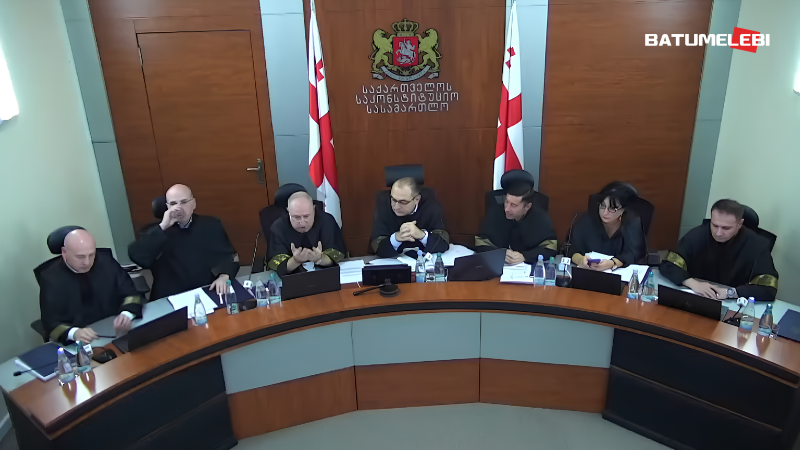
On November 18, the Kutaisi Court of Appeals upheld the Batumi City Court’s verdict, sentencing award-winning journalist Mzia Amaglobeli to two years in prison. Amaglobeli’s lawyers will appeal the decision to the Supreme Court of Georgia.
On August 6, Batumi City Court Judge Nino Sakhelashvili delivered the initial verdict, reclassifying the charges. Amaglobeli was initially charged under Article 353¹ of the Criminal Code of Georgia — attacking a police officer, an employee of the Special Penitentiary Service, or another representative of authority or a public institution — an offense punishable by four to seven years in prison. However, she was ultimately convicted under Article 353, Part 1 — resistance, threat, or violence against a protector of public order or other representative of the authorities — a lesser charge punishable by a fine, up to two years of house arrest, or imprisonment for two to six years.
Mzia Amaglobeli, co-founder and CEO of Batumelebi and Netgazeti, was arrested on January 12, 2025, and charged under the criminal code for slapping a police officer. Despite the absence of legal grounds for her continued detention, she remained in pre-trial custody until her sentencing on August 6.
Mzia Amaglobeli’s case is widely regarded as politically motivated, making her the first woman journalist recognized as a prisoner of conscience in Georgia since the Soviet era. Despite numerous appeals from press-freedom and human-rights organizations, EU member states, and the European Parliament for her immediate release, she remains imprisoned.
TrialWatch, of the Clooney Foundation for Justice, monitored her trial. Her case is currently pending before the European Court of Human Rights in Strasbourg.
Mzia Amaglobeli is an acclaimed journalist and the recipient of the 2025 Sakharov Prize.