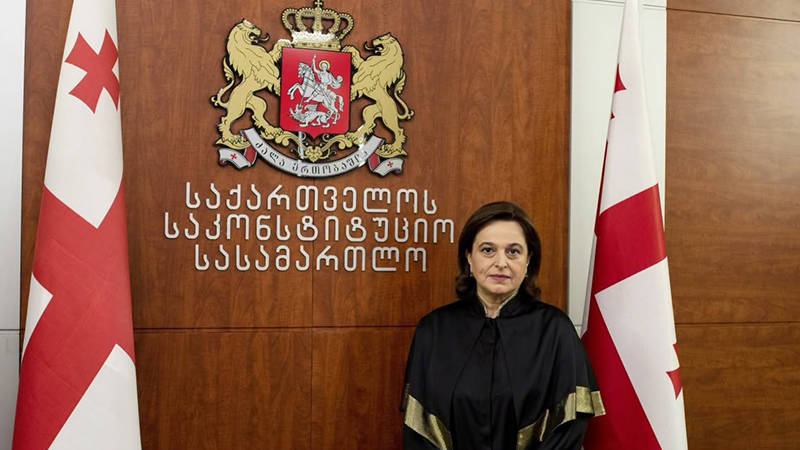
“A statement that the war was started by Georgia — no matter how bad a ruler Georgia had at the time, that ruler still represented Georgia — directly harms Georgia’s territorial integrity and the hope that one day it might be restored. This is a betrayal of the country’s interests, regardless of the fact that Irakli Kobakhidze is an illegitimate prime minister,” says analyst Kakha Gogolashvili.
According to the analyst, Kobakhidze’s statement about the August 2008 War will be used not only by Russia but could also influence the international community’s attitude toward Georgia.
In Gogolashvili’s view, Kobakhidze’s statement is a preparation of Georgian society for what Russia is demanding from its ally — Georgia’s illegitimate government: recognition of the independence of the Russian-occupied territories.
“Such a statement is made because Russia’s pressure on Georgia is strong — to sign a non-aggression pact with the occupied South Ossetia and Abkhazia. This practically means recognizing their independence. In order for this to be somehow justified in the eyes of the public later, Kobakhidze has launched this campaign, saying: ‘Look, we are the guilty ones,’” says Gogolashvili.
Batumelebi interviewed Kakha Gogolashvili, Director of the European Studies Center at the Georgian Foundation for Strategic and International Studies (Rondeli Foundation).

Kakha Gogolashvili
– Mr. Kakha, according to the prime minister of the “Georgian Dream’s” illegitimate government, in 2008 the war was started not by Russia but by the “Saakashvili;s bloody regime” at the instruction of the ‘deep state’. What does this statement mean to you?
– This statement contains many things. The first is betrayal of the country’s interests — regardless of the fact that Irakli Kobakhidze is an illegitimate prime minister. This statement is of great importance, first of all for the Russian audience and the Russian government, which will, of course, use it.
The second point: the claim that Mikheil Saakashvili started the war. Saakashvili did not invade Russia and did not start a war. You can accuse Saakashvili of escalating a conflict on his own country’s territory in a separatist enclave and raise the issue of whether he could have prevented this escalation. But under no circumstances can you accuse him of starting a war.
It is absolute nonsense to blame Saakashvili for starting the war: war means fighting another country, and in this case, another country invaded us — we did not attack another country.
The claim, repeated by Zakharova, that “our peacekeepers were attacked,” has never been proven. The Tagliavini Commission report explicitly states that Russia failed to present evidence that Georgian soldiers had killed Russian soldiers.
– The International Criminal Court in The Hague and the European Court of Human Rights have also ruled out Georgian responsibility for the August 2008 War.
– Yes, that is absolutely the case.
The third element in Kobakhidze’s absurd statement is dragging in the “deep state.” Of course, it is unclear what “Georgian Dream” means by this — whether they mean the then-U.S. government, or the U.S. administration, such as the intelligence services, or other agencies possibly acting without the central government — but in any case, this is a completely vague statement, made without evidence.
– You mentioned betrayal of the country’s interests. Do you believe Kobakhidze blames Georgia for starting the August 2008 War because he is carrying out the Kremlin’s orders? Kobakhidze did not mention Russia at all when talking about the war.
– When we talk about patriotism, betrayal of the country has several dimensions. First of all, it concerns the country’s territorial integrity.
A statement that the war was started by Georgia — no matter how bad a ruler Georgia had at the time, that ruler still represented Georgia — directly harms Georgia’s territorial integrity and the hope that one day it might be restored.
Kobakhidze’s statement also gives the international community a pretext to create divisions over supporting Georgia’s territorial integrity. This annihilates the possibility that Georgia could one day restore it by military force, because if Georgia is seen as responsible for provoking the conflict, it will no longer have support.
For example, when Azerbaijan restored its territorial integrity by military means, it had a fully legitimate right to do so, because it had not violated any international law concerning anyone in relation to Karabakh.
Thus, when Azerbaijan started armed conflict in Karabakh, the international community could say nothing significant and did not assist Armenia — everyone believed and knew that Azerbaijan had the legitimate right to reclaim its territories by force.
If Georgia is considered to have violated international law and caused war and destruction, then we know other examples — for instance, Kosovo, whose independence was recognized by much of the international community, including the civilized world, not just “savage” countries like Russia.
In the Israel–Gaza conflict, some accuse Israel of escalation and of violating humanitarian law, and thus actively support Palestinian independence.
Statements like Kobakhidze’s contribute to the loss of the country’s territorial integrity and minimize the chances of restoring it. A country must have the ability — and the enemy must know — that even if not now, it might one day try to restore its territorial integrity by military means. The enemy must know this, so they agree to negotiations.
Therefore, the consequences of this statement will be devastating for us: Zakharova has said that a non-aggression pact should be signed with South Ossetia and Abkhazia, followed by border delimitation.
This would deprive Georgia of any right to exert pressure — even the threat of military force. It means that Abkhazia and South Ossetia would never come to the negotiating table.
– The international community knows that Kobakhidze is an illegitimate prime minister. We understand the diplomatic and political harm — could there also be legal consequences?
– The international community is not monolithic: perhaps the United States will not act on it, but the political movements around someone like Trump are harder to predict — it’s not impossible that a future Trump-like administration might use this statement. So what if an illegitimate government makes such claims? In international relations, it is often not the sense of justice or humanitarian considerations that prevail, but interests. Later, statements like Kobakhidze’s are used to justify decisions.
First and foremost, Russia will use it — and other undemocratic countries like Russia.
In my opinion, such a statement today is more about the strong Russian pressure on Georgia to sign a non-aggression pact with occupied South Ossetia and Abkhazia, which would practically mean recognizing their independence. And for this to be somehow justified to the public later, Kobakhidze has started this campaign of “we are the guilty ones.”
– Does this explain why, in 2018, Kobakhidze said something different about who started the war — that it was Russia? “In 2008, of course, the aggressor that started the war was the Russian Federation…” he said seven years ago.
– Words lost their meaning a long time ago, especially in “Georgian Dream’s” rhetoric. We have often heard what Ivanishvili once said, and then how he changed it: he claimed he was building democracy but built authoritarianism instead. Words no longer matter — we have entered a stage where power, not words, decides.
– How decisive could the current developments in the South Caucasus be for defeating Russia? Besides Armenia and Azerbaijan moving away from the Russian orbit, yesterday the leaders of these countries met with the U.S. president.
– This process means that Russia will intensify its pressure on Georgia’s government, because Georgia remains the only place where Russia still has a chance to maintain a firm foothold in the Caucasus.
Russia’s grip here is not yet completely secure, as the vast majority of the population opposes it, but if the government manages to coerce the population, Russia will feel rehabilitated despite losing Armenia and Azerbaijan. Russia believes it will be able to fully pursue its strategic interests in the Caucasus through Georgia.
– Will Russia succeed, if the South Caucasus — and thus Georgia — appears on the U.S. agenda?
– In the cases of Armenia and Azerbaijan, the U.S. has specific, localized interests related to Iran: securing the Zangezur Corridor against possible Iranian aggression and creating leverage over Iran. U.S. presence along the corridor is also a means of influencing Turkey and Azerbaijan — the U.S. acts as a guarantor and facilitator between the Turkic world and Armenia.
For Armenia, this is an opportunity for strong access to Central Asia and the Turkic-speaking world — a vital interest for Armenia.
Turkey, too, will defend Armenia — Armenia will never again fall under Russian influence if it establishes good relations with Turkey and Azerbaijan. It will be in Turkey’s vital interest to protect Armenia from Russia.
Georgia, in this context, will be in a rather vulnerable position — Georgia will no longer be as important. The U.S. may no longer care about Abkhazia and South Ossetia if the Zangezur Corridor is secured. Whether Georgia falls under Russian or Turkish influence may no longer matter to them.
The only possible exception is that Turkey might set certain conditions for Russia regarding Adjara: not to restrict Turkish investments or trade between Turkey and Georgia. In other respects, even if Russia stationed military forces throughout Georgia, this might not pose a significant problem for Turkey.



![რას [არ] აკეთებს მერია ბათუმში უსახლკაროებისთვის – ინტერვიუ](https://batumelebi.netgazeti.ge/wp-content/uploads/2026/10/covers-batumelebi-3-1.png "რას [არ] აკეთებს მერია ბათუმში უსახლკაროებისთვის – ინტერვიუ")