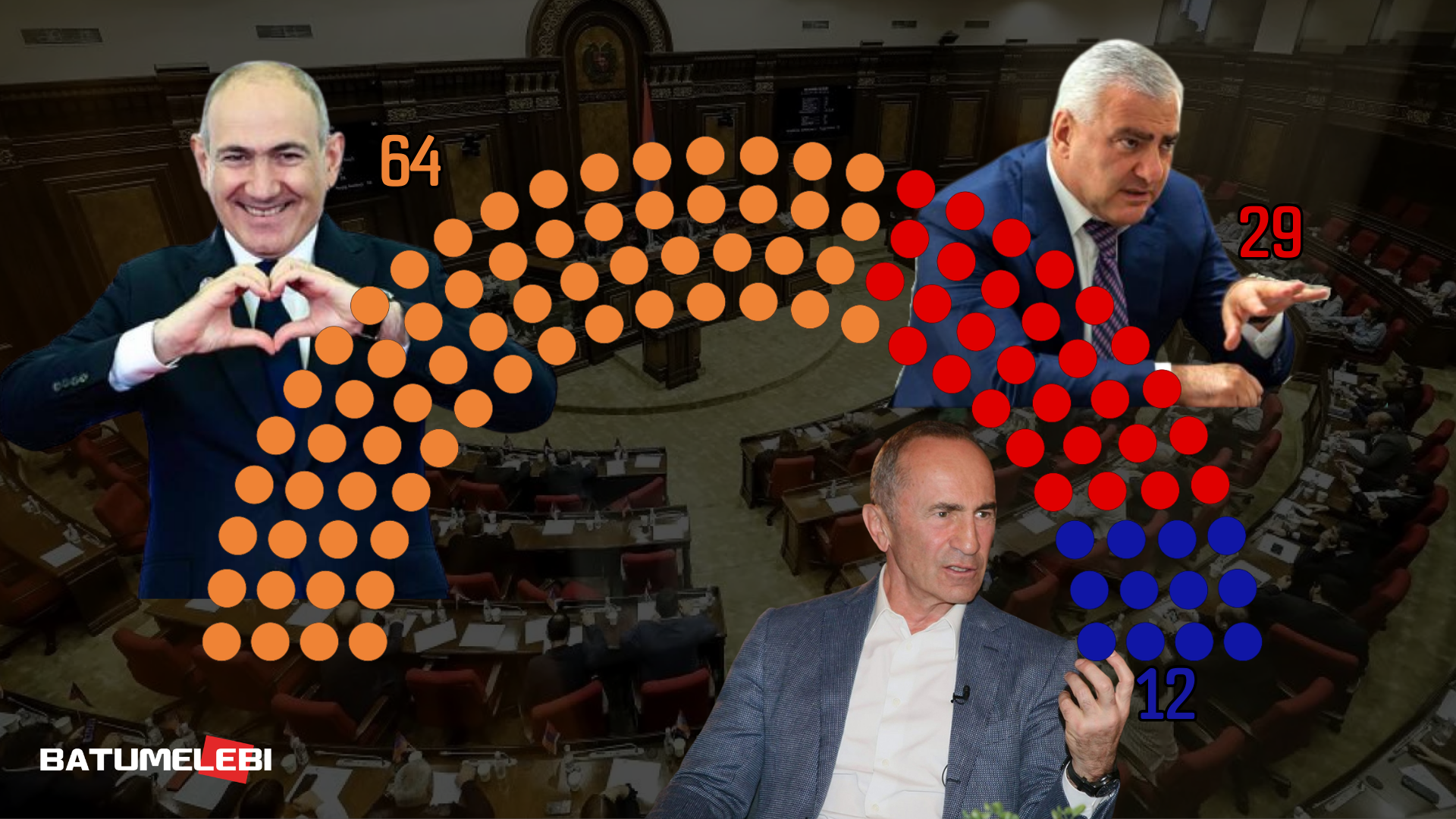
According to the final results of the latest parliamentary election, three political forces will be represented in Armenia’s new National Assembly (Parliament):
- Civil Contract Party
- Strong Armenia Alliance
- Armenia Alliance
The distribution of seats will be as follows:
- Civil Contract Party – 64 seats
- 64 – 29 seats
- Armenia Alliance – 12 seats
At the last moment, the Prosperous Armenia Party appeared to have crossed the 4% electoral threshold, but the final results changed the picture and left the party without parliamentary representation.
Armenia’s Central Electoral Commission has completed counting ballots in the regular parliamentary election. Results from all 2,005 polling stations have been counted.
The votes were distributed as follows:
- In first place was the Civil Contract Party, receiving 727,160 votes (49.81%)
- In second place was the Strong Armenia Alliance with 340,062 votes (23.29%)
- Third place went to the Armenia Alliance, which received 145,097 votes (9.94%)
- In fourth place was the Prosperous Armenia Party with 58,368 votes (4.00%)
- The United Homeland Party, which came fifth, received 33,618 votes (2.30%)
According to official data, 58.97% of eligible voters took part in the election.
Armenian voters were largely choosing between the ruling party led by Nikol Pashinyan and political forces broadly described as pro-Russian.
A total of 18 political entities were registered to participate in the election: 16 parties and 2 alliances. Among them were Prime Minister Nikol Pashinyan’s Civil Contract Party, Robert Kocharyan’s Armenia Alliance, and the Strong Armenia Alliance, led by Narek Karapetyan, described as a pro-Russian oligarch and indirectly supported by Moscow.
Because of the ruling party’s and Nikol Pashinyan’s pro-Western orientation, the opposition warned that Armenia risked a complete breakdown in relations with Russia and a deep economic crisis.
Due to his openly pro-Western political course, Pashinyan also faced direct and indirect messages from Moscow, including references to “the Ukrainian scenario.”
In addition, ahead of the election, several international investigative reports were published alleging that Moscow had attempted to influence Armenia’s election through various channels and networks.