By decree, the Georgian Dream government has approved the number of student places at state universities for the upcoming academic year. The move follows a controversial higher education reform, widely seen as an attempt to consolidate control over the education system. Based on the principle of “one city, one faculty” and changes to faculty quotas, the reform has drawn criticism from educators and experts.
Education experts Shalva Tabatadze and Ketevan Chachkhiani have published a comparative analysis of the new quotas against the 2025 undergraduate admissions figures.
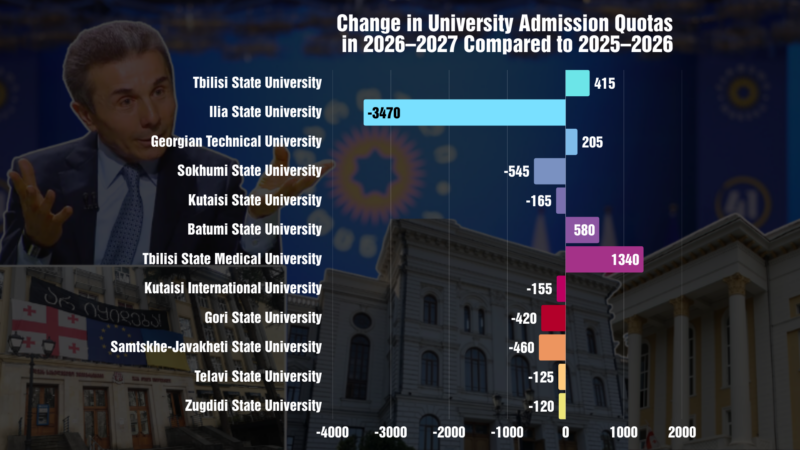
According to their findings, the total number of undergraduate places at state universities has been reduced by 3,000 compared to the 2025–2026 academic year. Ilia State University will experience the sharpest cut: the number of students it can admit has decreased by 92% under the new quotas.
The experts outline the following key trends:
- Compared to 2025–2026, the number of undergraduate places at state universities has decreased by 3,000.

- The total number of admitted students has increased at Ivane Javakhishvili Tbilisi State University (TSU), Georgian Technical University (GTU), Batumi Shota Rustaveli State University, and Tbilisi State Medical University.
- Ilia State University’s programs have been significantly reduced, leaving only pedagogy and ABET-accredited programs. As a result, its admissions capacity has dropped by 92%. Student places have also been reduced at Sokhumi State University, both universities in Kutaisi, as well as Gori, Samtskhe-Javakheti, and Telavi state universities.
- By field of study (the experts analyzed seven of the most in-demand disciplines to identify trends), there have been sharp reductions in law, business administration, economics, international relations, psychology, and sociology — both in Tbilisi and in the regions. Moreover, students at Gori, Telavi, Zugdidi, and Samtskhe-Javakheti universities will no longer have access to these programs.
- The total number of places in computer science, computer engineering, information technology, and informatics has increased, including in Tbilisi, Kutaisi, and Batumi. However, students at Gori, Telavi, Zugdidi, and Samtskhe-Javakheti universities will no longer have access to these fields.
- Although Georgian Technical University no longer offers social and political sciences, law, or business programs — retaining only engineering, technical, technological, and agricultural fields — its 2026–2027 quota still exceeds the number of places announced in 2025–2026. This indicates a significant increase in admissions to its specialized engineering and technology programs.
- The decree does not provide exceptions for students enrolled under the 1+4 quota system, whose number reached up to 1,500 at state universities in 2025–2026. These students must choose undergraduate programs this year, meaning that approximately 1,500 of the 21,300 allocated places will need to be distributed among them. Students enrolled in the 1+4 programs at Samtskhe-Javakheti, Telavi, and Gori universities are expected to face difficulties selecting undergraduate programs in 2026–2027, as the programs they may wish to continue will no longer be available at their institutions.
The experts also highlight additional changes:
- An integrated teacher education program has been added for 2026–2027 at Ilia State University, Sokhumi State University, and regional universities, with 1,300 places allocated. This program did not exist among undergraduate offerings last year.
- The primary education teacher training program has been removed entirely from the list of programs.
On February 12, the Georgian Dream government formally approved the new admission quotas for state universities.
Education Minister Givi Mikanadze stated that quotas would be distributed according to the “one city, one faculty” principle, taking into account each university’s “traditional profile.”