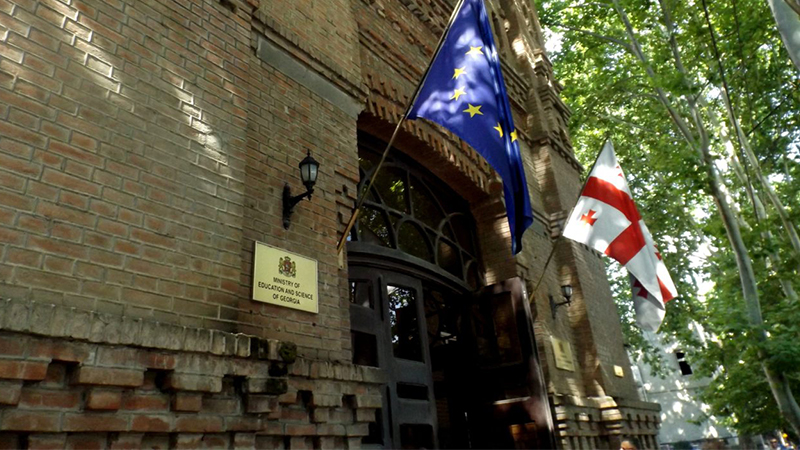
On February 12, the the Georgian Dream government approved student admission quotas for state universities.
The announcement regarding the quotas was made by Minister of Education, Givi Mikanadze.
According to him, quotas for state universities will be distributed on the principle of “one city, one faculty,” taking into account each university’s “traditional profile.”
At Tbilisi State University, admissions will be announced in fields such as: exact and natural sciences, humanities (excluding pedagogy), law, economics and business administration, and social and political sciences.
At the Georgian Technical University, admissions will be announced for engineering and technical disciplines.
At the Medical University, admissions will be for medical programs.
At Ilia State University, admissions will cover pedagogy programs and STEM fields with ABET accreditation.
At Sokhumi State University, admissions will be in agricultural fields, Georgian-Abkhaz language and literature, and pedagogy programs.
Art universities will admit students to their respective specialized programs.
Batumi Shota Rustaveli University and Kutaisi University will maintain a multi-disciplinary focus.
At the universities of Zugdidi, Gori, Akhaltsikhe, and Telavi, the focus will be on agricultural fields, tourism, and pedagogy.
Mikanadze stated that:
“this year, student enrollment in higher education institutions will be based on labor market demands.
However, to avoid sharply reducing admissions in certain programs, such as law, the number of students to be enrolled this year will be determined by an interim quota.
All universities will retain their unique educational programs. The only exception allowed at this stage is the full continuation of programs with international accreditation or joint/dual-degree programs.
Last year, 19,311 students were enrolled in state universities. This year, the intake is expected to increase by about 2,000 students, bringing the total to 21,300.
Additionally, around 10,000 students will be admitted to vocational programs, which will be provided free of charge.”
According to Mikanadze, the agricultural program will temporarily remain at the Georgian Technical University, and admissions will be announced under the Technical University’s name.
“In the coming days, a reorganization process will begin, under which, in a few months, the agricultural program will move under the jurisdiction of Sokhumi State University. Accordingly, students newly admitted to the agricultural faculty in the 2026–2027 academic year will begin their studies at Sokhumi State University.
Admission to the established quotas will be allowed as an exception in cases where two or more students score equally on the national exams and fall at the last place. It will also apply to individuals living in occupied territories who wish to study without taking the national exams,” Mikanadze said.
He added that over the past five years, an average of 3,598 students enrolled in law faculties across various universities, while only 2,047 completed their studies, whereas the labor market demand for lawyers is less than 700 per year. “As a result, the previous practice sacrificed 2,900 of the 3,600 law students, preventing them from ever finding employment as lawyers”.
“A similar situation exists in economics and social and political sciences. Specifically, in economics, the average annual enrollment is 1,053 students, with only 662 completing their studies, while labor market demand is 150 graduates.
In social and political sciences, the average annual enrollment is 4,916 students, with 2,591 completing their studies, while labor market demand is about 400 graduates.
By contrast, there is a significant shortage in engineering and technical fields, where over the past five years, an average of 2,225 students were admitted annually, but only 1,200 graduated, while labor market demand is 1,800 graduates.
It is also noted that as the economy grows, demand in engineering and technical fields will increase year by year.
Enrollment figures for medical and veterinary fields do not meet labor market demands,” Mikanadze said.
He emphasized that quotas for state universities will follow the “one city, one faculty” principle and consider each university’s traditional profile. However, at today’s briefing, Mikanadze did not specify the exact number of quotas allocated to each university.
Reducing student numbers in state universities is part of the reform of the Georgian Dream party. As early as November 2025, Kobakhidze stated that student numbers in Tbilisi should decrease to 60%.
“The remaining 40% should be redistributed to other cities. This is the main direction of the concept,” Kobakhidze said.
The education reform of the Georgian Dream party has been sharply criticized by professionals in the educational sector.
‘Reform’ to Seize Total Control: Georgian Dream Targets Education System