Introduced amid mass protests and a freeze on EU integration, Georgian Dream’s education reform is reshaping Georgia’s universities and schools in ways that experts say threaten academic autonomy, international cooperation, and students’ freedom of choice.
What Does Georgian Dream’s Reform Change in Higher Education?
♦ “One city, one faculty” principle: State universities will no longer be allowed to offer identical academic programs. This will inevitably lead to faculty closures and academic staff layoffs.
♦ Shortened degree programs: Bachelor’s, master’s, and doctoral programs will be reduced by one year, effectively removing Georgia from the Bologna Process. As a result, Georgian students will lose access to EU exchange programs, and continuing studies abroad will become problematic due to academic incompatibility. This move isolates Georgia’s education system and shuts a critical window of opportunity for young people seeking quality education in Europe, the U.S., and beyond.
♦ Abolition of university autonomy: The state will decide which programs each university may offer, stripping both institutions and students of choice.
♦ Restrictions on grants: Under the new grants law, universities and researchers lose the ability to participate in international projects. Scientists are barred from receiving foreign funding without government approval.
♦ Isolation of academic life: Two major universities were merged without consulting academic staff, triggering protests.
♦ Planned sale of university property: The reform envisages the possible privatization of state university assets.
♦ Forced redistribution of students: According to Kobakhidze, 60% of students should be relocated to the regions—again, without consultation with experts, universities, or students.
Public and Academic Response That Preceded the Reform

December, 2024 – Protest in Tbilisi
After the ruling Georgian Dream (GD) party announced that it was suspending Georgia’s EU integration process, widespread unrest erupted across the country. Citizens who took to the streets described the decision as an anti-state move.
Educational institutions also became actively involved in the unfolding events. School pupils and university students joined the protest rallies.
A number of schools and universities circulated petitions in support of European integration, emphasizing that Georgia’s future lies in the European Union and that Georgian Dream’s anti-Western policies are unacceptable.
One such petition, circulated on December 1, 2024, and signed by nearly 3,000 teachers, stated: “Silence in the face of the processes unfolding in Georgia today is a crime.”
The Georgian Dream government violently dispersed the protests, beating and injuring hundreds of citizens, including journalists.
Teachers and students also protested the brutal violence inflicted by riot police on demonstrators.
As a sign of protest, students launched continuous demonstrations at Tbilisi State University (TSU), Ilia State University (Iliauni), and Batumi Shota Rustaveli State University (BSU).
Public servants, lecturers, and professors signed pro-European integration petitions, demonstrating the broad-based nature of resistance.
Party-driven purges affected nearly every sector and all public institutions.
Alongside repressive legislation, Georgian Dream’s Prime Minister launched attacks on universities, announcing plans to “cleanse” them. He used particularly hostile rhetoric toward Ilia State University, its rector, and faculty members, labeling them “United National Movement supporters.”
In an effort to suppress student protests and establish full control over educational spaces, Georgian Dream initiated a so-called “reform” aimed at merging universities, abolishing some of them, and relocating others out of the capital.
Prime Minister Irakli Kobakhidze publicly stated that the goal of the “reform” was to “relieve” Tbilisi of students. According to him, 80% of students are currently concentrated in the capital, and this share should be reduced to 40%.
Once again, Georgian Dream made the decision without any discussion or consultation – no debate, no dialogue with students or academic staff – triggering a new wave of discontent within universities.
Education specialists have dubbed Georgian Dream’s education “reform” a “deformation of education.”
The Georgian Dream approved a new education concept on January 28, 2026.
The “reform” began with the abolition of the 12th grade in public schools.
Control Over Higher Education
The first blow of the “reform” struck Tbilisi State University and Georgian Technical University. Georgian Dream announced their merger without informing either academic staff or students.
This decision sparked outrage among some university professors. According to TSU Associate Professor Teona Mataradze, the issue of rector accountability must be raised if the decision was made unilaterally.
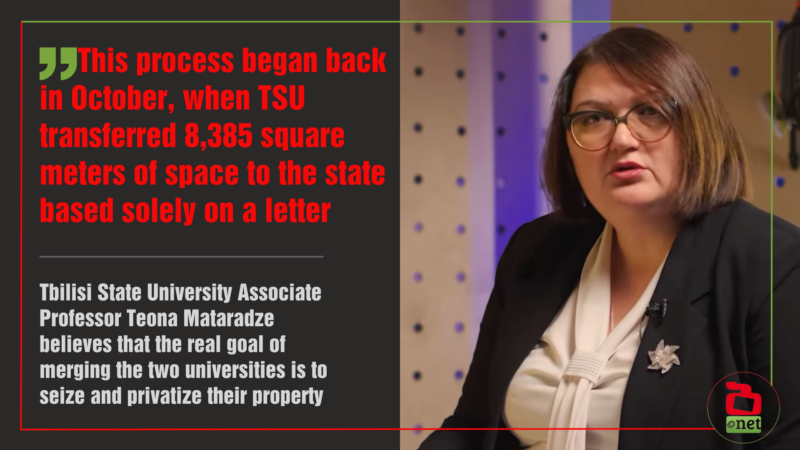
She believes the true goal of the merger was to seize and privatize university property.
“This process began back in October, when TSU transferred 8,385 square meters of space to the state based solely on a letter,” Mataradze says.
GD Prime Minister Kobakhidze has not concealed the possibility that university buildings may be sold.
More than ten days after the announcement, Kobakhidze stated on February 9, 2026 that it has been agreed that TSU and GTU will not merge, and that the Georgian Technical University will retain only its technical faculties, no longer admitting students to its humanities programs.
According to him, relocating universities to the regions will “unburden the city.” New campuses for relocated universities are to be built in Rustavi and Kutaisi.
However, Kobakhidze has not specified when construction would begin or how it would be financed.
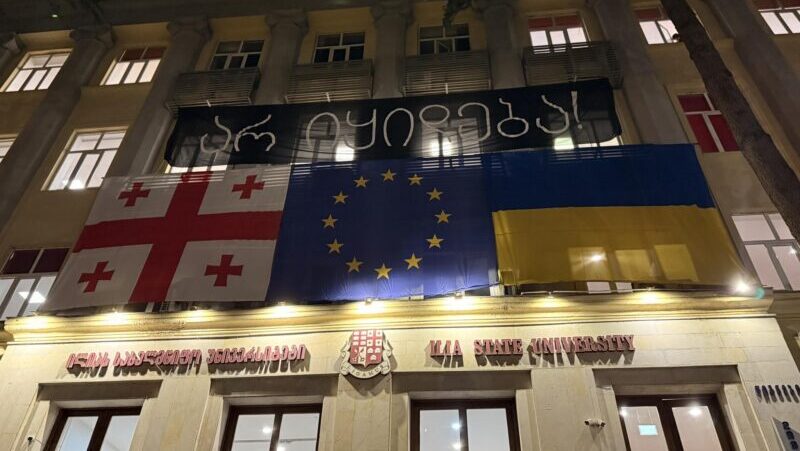
“Not for Sale” reads the banner on the Ilia State University building, hung by students on November 5, 2025, in response to the announced reform
Education experts argue that a government which failed to build schools and kindergartens – and arrested company representatives over alleged embezzlement of millions – will be unable to create modern university centers equipped with advanced technologies within two years.
They believe Georgian Dream aims to dismantle and neutralize educational institutions critical of the government, isolate them from the Western world, and bring both academic staff and students under strict control.
“GTU was the quietest university, yet it was the first to be targeted,” says Teona Mataradze, – “Compliance did not save GTU. People fail to realize that obedience is not a guarantee you’ll keep your position tomorrow.”
According to Mataradze, Ilia State University is Georgian Dream’s next target.
Universities Without Grants, Dependent Solely on the State Budget
The vast majority of scientific research at Georgian universities is funded by Western grants, while state funding for science remains minimal. Georgian Dream’s reform prohibits universities from enrolling foreign students and receiving international grants.
The government has also ended student funding by abolishing state grants, announcing that from the 2026–2027 academic year, it will finance only those programs permitted to remain at state universities.
Under the “one city, one faculty” principle, state universities will no longer be able to offer similar programs, leading to further staff reductions and rising unemployment.
Kobakhidze has stated that each faculty will have only one professor, paid 10,000 GEL, while all other academic staff may continue working only as assistants.
Universities will no longer be able to decide which programs to offer, how long they last, or whom to collaborate with.
“In Soviet universities, there was no choice. Freedom of choice was the key advantage of integration with the European educational space – and this is precisely what the government is attacking. It wants to strip applicants and students of choice and turn them into puppets who move solely according to government instructions” says TSU Professor Iago Kachkachishvili.
Ilia State University professor Manana Ratiani says Georgian Dream is suffocating universities.
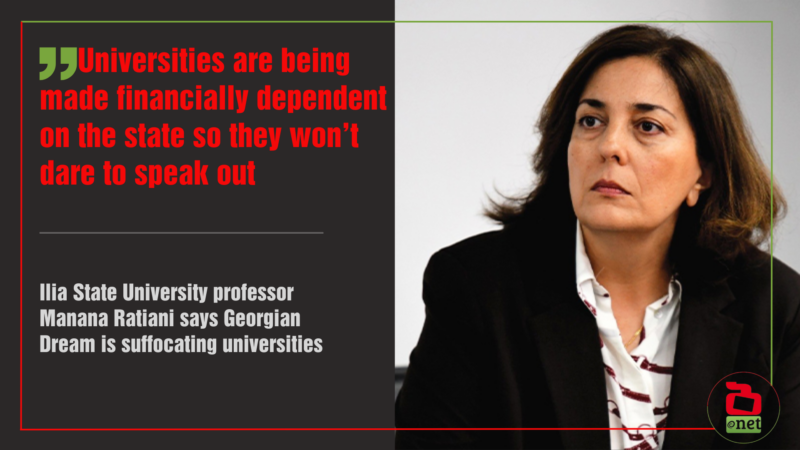
“We see how universities are being choked. Seven priorities were named without any research basis. Our students are accustomed to democratic governance and participation in decision-making – they are not easy to control. Nor is our faculty.
Universities are being made financially dependent on the state so they won’t dare to speak out.”
She notes that Western grants and assistance have been halted, projects reduced to a minimum, and only ongoing initiatives are being completed. Erasmus programs were presented as an exception, but Ratiani questions how students will participate if Georgian diplomas are no longer recognized.
Education experts argue that the reform contradicts Georgia’s Constitution by violating principles of academic freedom and university autonomy. It is incompatible with the Magna Charta Universitatum and the Bologna Process and threatens Georgia’s integration into the international academic space.
Education expert Simon Janashia also believes the reform’s goal is total government control over universities:
“There is a real risk that Georgian Dream seeks to subordinate the education system to serve its grip on power and distance it from modern educational trends and European education. Georgian Dream leaders themselves say that apparently we must defend ourselves against ‘harmful Western influence.” he says.
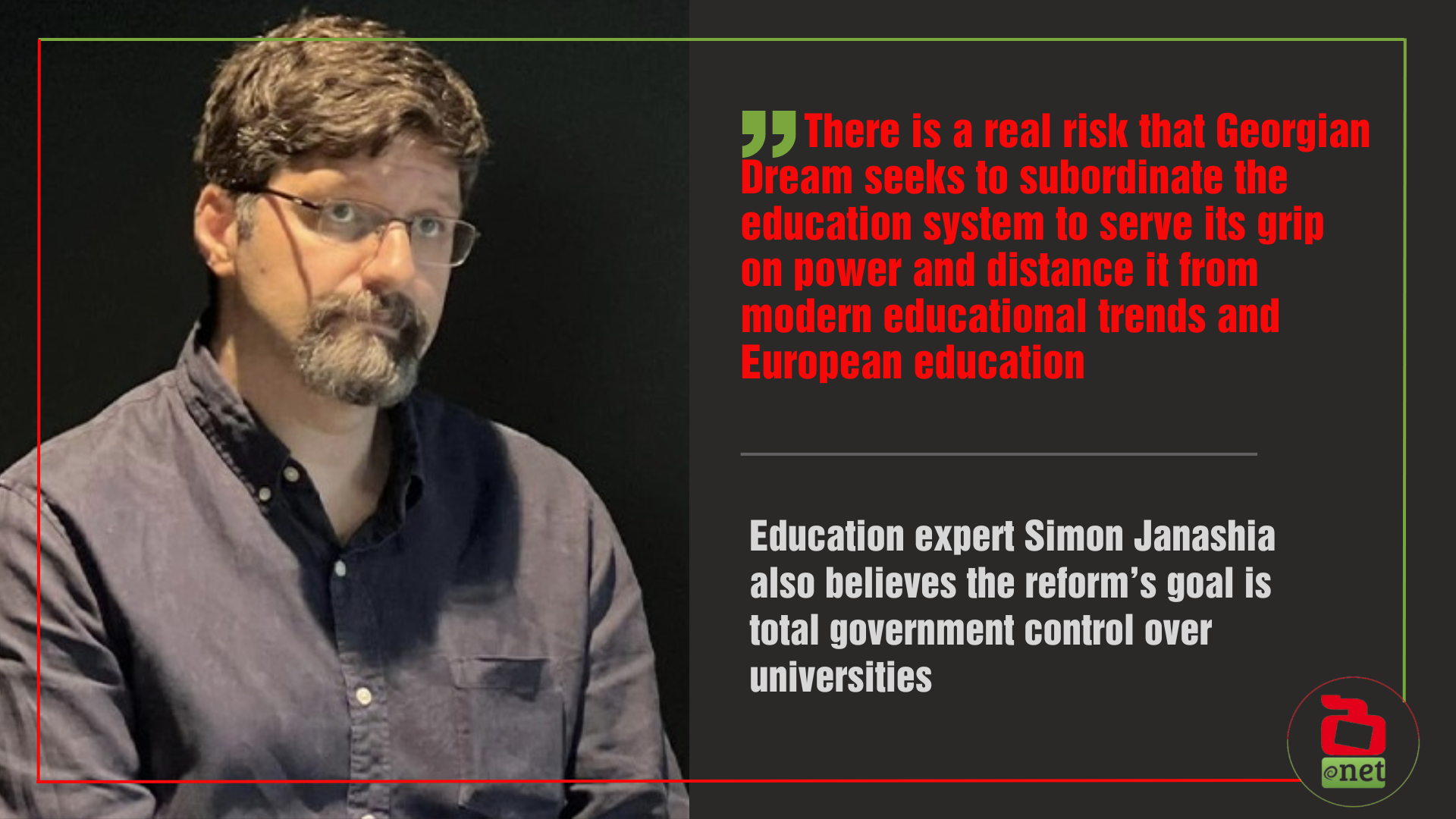
“In Europe, universities serve society – not political parties. Parties implement concepts developed within academic spaces, not the other way around,” Janashia adds.
Ilia State University professor Giga Zedania recalled the higher education reform launched in Russia in 2012 in a post on his social media page:
“In 2011, Russia had 1,115 universities.
The number of students stood at approximately 7 million.
The gross enrollment ratio was 76.5% (i.e., the proportion of students relative to the relevant youth age cohort).
In 2012, after Vladimir Putin returned to the presidency, a reform of higher education was launched.
Its main slogans were optimization, efficiency, and reorganization.
Hundreds of universities were merged or shut down.
By 2021, as a result of the reform and prior to the invasion of Ukraine, only 720 universities remained in Russia [after the invasion, statistics became distorted due to the incorporation of universities from occupied territories, etc.].
The number of students had dropped to approximately 4 million.
The gross enrollment ratio fell to 54.9% (this period coincided with a demographic collapse and an increase in the number of international students; otherwise, it would have dropped to as low as 44%).
Young people who were pushed out of universities were sent to war.
P.S. The sale and privatization of university property continue to this day.”

Changes to General Education
- The reform also affects primary and secondary education:
- The 12-year school system has been abolished, disconnecting public schools from the Bologna Process.
- Only private schools – and select public ones – retain the right to offer 12 years of education.
- Teachers’ rights have been restricted under the career development scheme; they may no longer take additional jobs without written permission from school directors, despite low salaries.
- Private tutoring and teaching at private centers have been limited.
- Basic education has been reduced to 10 years, while the 11th grade has been designated as a preparatory year.