Georgia’s Public Defender has presented its 2025 annual human rights report to parliament, also flagging concerns over protest-related enforcement, due process violations, prison deaths, and rising child poverty.
The 427-page report, released on March 31, reviews the state of human rights and freedoms across the country and highlights several systemic problems.
Double jeopardy concerns in Mzia Amaglobeli case

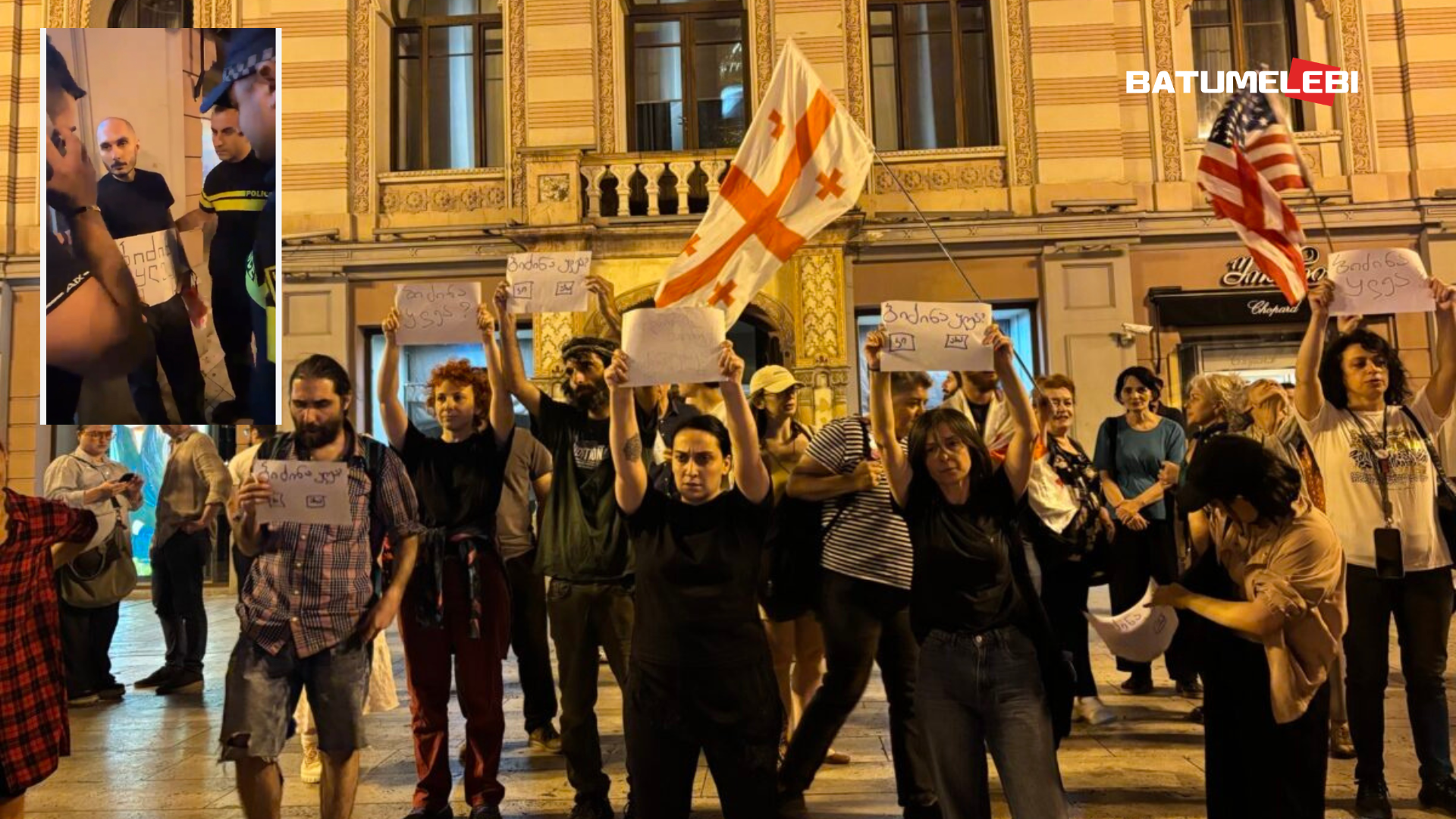
Several months apart, Judges Salikh Shainidze (top right) and Marina Fomaeva (bottom right) heard two separate administrative cases brought by the Ministry of Internal Affairs against Mzia Amaglobeli over the same incident — placing a poster in solidarity with arbitrarily detained citizens and in support of freedom of expression. Both judges found her liable for the same act and imposed fines.
The report finds that the principle of Non bis in idem — prohibiting double punishment — have been violated in the case of Batumelebi&Netgazeti founder Mzia Amaglobeli. She was first sanctioned over a January 11, 2025 protest incident in Batumi, including placing a sticker on a wall of police gate supporting building.
She was first charged under Article 173(1) of the Administrative Offenses Code, which covers disobedience to a lawful police order. In court, her lawyers argued she had only placed a sticker and had not engaged in any disobedience or other unlawful conduct. However, the court treated the act of placing the sticker itself as “disobedience” and found her liable under Article 173.
Several months later, police initiated a second administrative case against her under Article 150, which concerns damaging or altering the appearance of municipal property. The second charge was based on the same incident — same date, location, and action (placing the sticker on the police gate supporting construction).
The Public Defender says this raises serious concerns under the double jeopardy principle (non bis in idem), as Amaglobeli was effectively pursued twice for the same conduct. The ombudsman also warned that treating such acts as administrative offenses risks unjustifiably restricting freedom of expression and peaceful protest.
However Amaglobeli was found liable twice for the same offense. The case has also been taken to the European Court of Human Rights.
8,200 protest-related violations recorded in one year

Law enforcement officers deployed to arrest or disperse protesters often cover their faces and wear no identifying insignia, making it impossible to identify those who beat citizens or commit other violations.
The report documents extensive use of Article 174(1) of the Administrative Offenses Code — governing assemblies — after recent legislative changes. Between November 2024 and October 2025, police recorded 8,200 alleged violations, affecting 4,070 individuals including 415 foreign citizens.
Many cases stemmed from broadly defined or newly penalized conduct, including wearing face coverings, standing on sidewalks, or being present on roadways during protests. The Public Defender notes that these changes were applied actively and often restrictively in practice.
Court review also raised concerns. In some cases, individuals were sanctioned simply for being present in an area where a road had already been blocked by others. Courts relied on video footage but often failed to assess whether the footage actually proved participation in a protest or obstruction. In at least one case, a person was given administrative detention, while another — who had a recognized disability — was found liable but only issued a warning.
The report also criticizes the lack of legal clarity around what constitutes “artificially blocking a roadway,” warning that vague definitions allow for inconsistent enforcement and risk arbitrary restrictions on assembly rights.
24 prisoner deaths, no prosecutions

Photo from Batumelebi’s archive – Rustavi Women’s Prison
In 2025, 24 prisoners died in custody or in civilian clinics, including two suicides. All cases were opened under the same charge — negligence leading to death — but no one has been prosecuted so far.
The Public Defender highlights systemic delays in forensic examinations as a key barrier to effective investigations. In 16 cases, expert reports — mostly forensic medical opinions — were still pending at the time of reporting. In some instances, results had not been delivered even two years after being ordered.
The report also notes a lack of transparency: the state forensic bureau has recently stopped responding to inquiries about delays. According to the ombudsman, these shortcomings undermine the state’s obligation to conduct prompt and effective investigations into deaths in custody.
A broader trend is also noted: while yearly figures fluctuate, the number of prison deaths has shown a slight upward pattern in recent years.
Rising numbers in social assistance signal child poverty risks

Photo from Batumelebi’s archive
The report points to a sharp increase in the number of children registered in the social assistance system, with 379,957 children listed and 23,322 newly registered in 2025.
278,639 children receive subsistence benefits, and 129,329 families with children depend on this support. While improved access to programs may partly explain the rise, the Public Defender stresses that the figures also reflect growing socio-economic hardship.
Emergency assistance programs expanded significantly, covering nearly 6,000 families in crisis — well above the previous year. However, the report finds these programs are largely reactive and fail to address long-term needs. Families often remain dependent on aid without gaining the support necessary for sustainable economic stability.
Services such as shelters for mothers and children remain limited in scope and capacity. The report emphasizes the lack of comprehensive data on child poverty and calls for deeper, systemic analysis to inform effective policy responses.