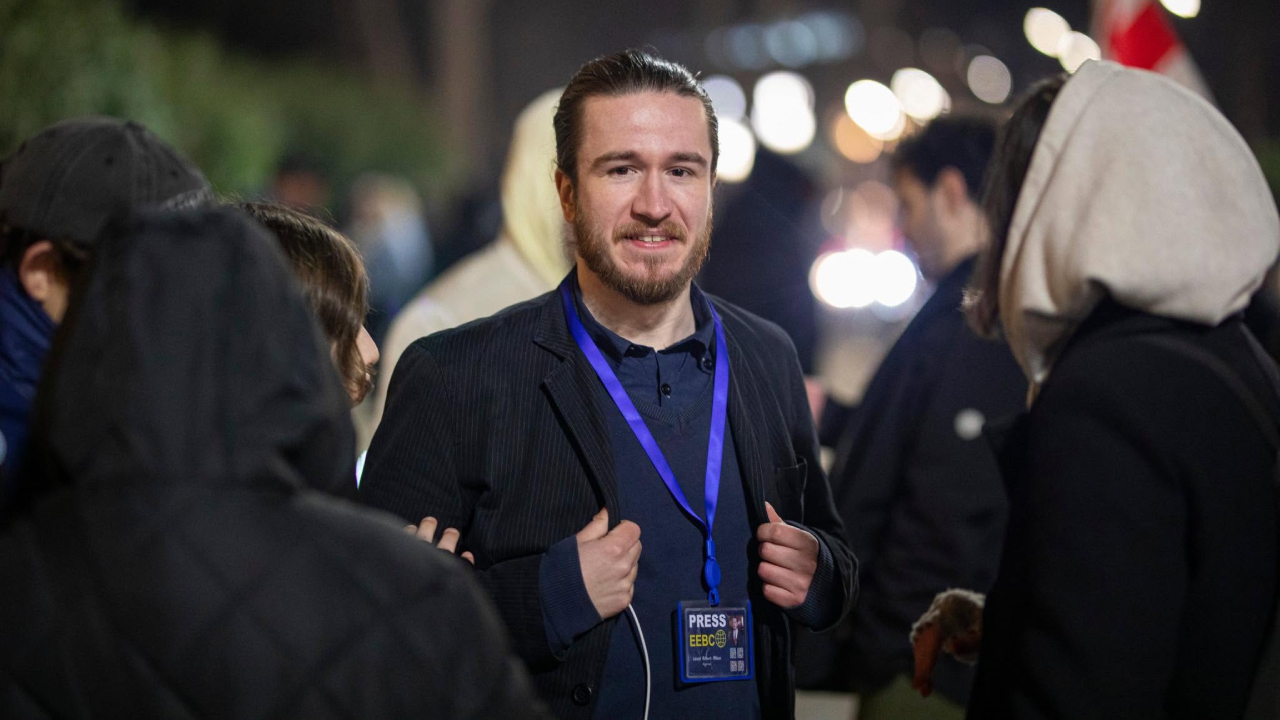
Journalist and Formula TV anchor Vakho Sanaia has been ordered to serve 14 days of administrative detention over Facebook posts, following a case brought against him over alleged insults directed at public officials. He becomes the first journalist in Georgia to be ordered into detention over social media posts.
Sanaia’s detention comes after he was previously fined 6,000 GEL over another Facebook post, which he wrote sarcastically in response to a newly established devision within the Ministry of Internal Affairs tasked with monitoring social media content and initiating administrative proceedings over allegedly offensive posts. The division is officially called ” Division for Combating Hate Speech, but critics call it “scroll-screening division”, saying people employed there have to scroll the social media and make screenshots of posts, to start administrative cases.
The original post, which resulted in the fine, was a sarcastic message in which Sanaia urged people “not to call Shalva Papuashvili and Lado Bozhadze d*cks.” The post was written in response to the creation of the new monitoring mechanism, which critics have dubbed the “scroll-screening division.”
After receiving the fine, Sanaia published additional posts commenting on the case and mocking the decision. In one of them, he suggested ironically that “the court’s ruling implied that Papuashvili and Bozhadze were, in fact, d*cks”.
Those follow-up posts became the basis for a new administrative case against the journalist.
During the court proceedings, the Ministry of Internal Affairs argued that Sanaia’s posts represented an “ironic and concealed form of insult.” The ministry also cited the fact that Sanaia had already been fined in a previous case involving alleged insults toward a political officeholder and requested administrative detention instead of another financial penalty.
The court granted the request and ordered Sanaia to serve 14 days of administrative detention.
Sanaia did not attend the court hearing. Following the ruling, he continued commenting on the case on social media, saying that neither fines nor detention would force him to limit his freedom of speech or stop expressing his views.
The case comes amid growing concerns among media freedom and civil society groups over the use of administrative laws to penalise speech in Georgia.
According to Transparency International Georgia’s latest updated list, there are currently 90 political prisoners in the country. Critics argue that recent legislative changes and enforcement practices have increasingly been used against protesters, activists, journalists and government critics.
The Ministry of Internal Affairs’ new social media monitoring unit, officially known as the Division for Combating Hate Speech, has already submitted dozens of cases to courts, many of which have resulted in financial penalties.