A so-called pre-trial hearing was held in court in the case concerning the prosecution of opposition politicians, allegedly on the grounds of crimes committed against the state – “sabotage case”.
The court deemed all evidence submitted by the prosecution admissible and moved the case to the merits stage.
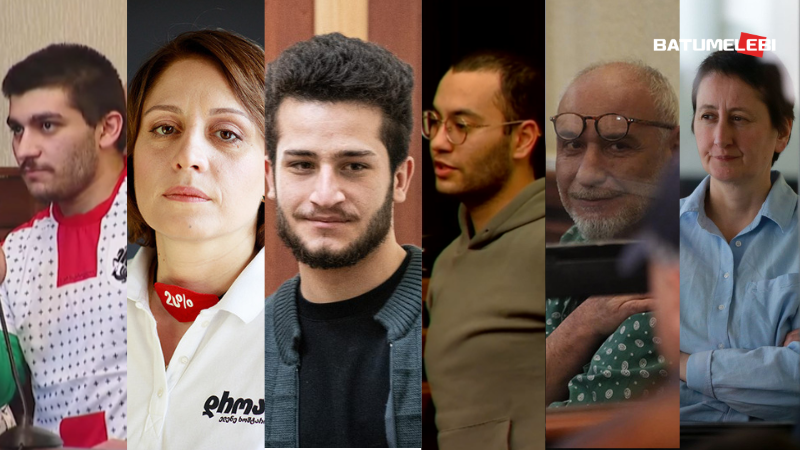
The case concerns the so-called “sabotage” charges, with defendants including Mikheil Saakashvili, Giorgi Vashadze, Nika Gvaramia, Nika Melia, Zurab “Girchi” Japaridze, Elene Khoshtaria, Mamuka Khazaradze, and Badri Japaridze. Melia, Khoshtaria, and Khazaradze did not attend the hearing. Khazaradze is not currently in Georgia, while Melia and Khoshtaria, according to their lawyers, refuse to take part in what they describe as a political farce.
At the pre-trial hearing, the court considers whether evidence is admissible. If the court concludes – after hearing arguments from both sides – that there are sufficient grounds, the case then proceeds to substantive hearings, where evidence is examined. This is the procedure established by law. However, in ongoing and already concluded politically motivated cases, judge ignored all arguments put forward by lawyers representing political prisoners/defendants and have fully satisfied all motions submitted by the prosecution.
During the pre-trial hearing, both the accused politicians and their lawyers protested against the prosecution because the case materials fail to clearly specify which evidence relates to which defendant. Moreover, the defense argued that the evidence presented by the prosecution is entirely irrelevant to the case. Lawyers say this severely restricts their ability to defend their clients, as it remains unclear which evidence they should challenge as inadmissible, how such motions should be substantiated, or how the judge is expected to make an informed decision.
“People are being tried for their political activities. The case file contains every interview Badri Japaridze and Mamuka Khazaradze have ever given. This is treated as part of the indictment and supposedly as elements of sabotage. Witness statements by Nana Kakabadze and Vato Shakarashvili are submitted as evidence. What exactly are their opinions evidence of? I’ll leave that as a rhetorical question. […] As evidence, the prosecution has submitted records of viewing Zelenskyy’s website and Arakhamia’s website. I cannot connect this to the case – not legally, not even logically. I don’t have that much imagination.
[…] We’ve reached the point where political statements by politicians can serve as grounds for prosecuting them for sabotage. This is not only unlawful – it is dangerous,” said lawyer Zviad Kordzadze, who represents Mamuka Khazaradze.
Lawyer Ketevan Chomakhashvili, who represents Nika Gvaramia, requested that the entire body of case materials be ruled inadmissible. She argued that most of the materials have “no connection whatsoever to Nika Gvaramia.” As for the remaining two witness interview records – where Gvaramia’s name is merely mentioned – she said they constitute “indirect testimony, which is not direct evidence.” Accordingly, indirect testimony cannot be used as a basis for bringing charges or issuing a verdict.
Nika Gvaramia also addressed the court in two separate episodes. Below are the main points from his statements:
“This case consists of more than 40 volumes, doesn’t it? I searched and searched but couldn’t find ‘Nika Gvaramia’ — a clearly identified defendant accompanied by any informant saying, ‘Here is what Nika Gvaramia did.’
It should say: ‘This harmed the country.’ It caused this and that. This and that person committed these acts, at this time, in these circumstances, through these actions. None of that exists in the indictment. A criminal statute is cited, types of evidence are listed, and it simply says that this “proves” Nika Gvaramia’s guilt. If, instead of my name, the name Valerian Bugianishvili [the judge] were written there, nothing would change. There is nothing about me personally in the indictment – neither in the charges nor in the evidence.
At least before, I knew what I was accused of – putting my wife in a service car and refusing to go to Tsulukiani (Commisson). Here, I have no idea.
In 40 volumes, there are exactly two sentences where I’m mentioned. Two police officers – Kakha Lamazoshvili and Nika Namelashvili – say that five or six people were standing there, and one of them might have been Nika Gvaramia, talking about something, though they couldn’t hear what he was saying.
On what basis are you supposed to assess anything in such a multi-unknown equation? I haven’t even been interrogated so that I might have said something you could use. What if I deny that I was even there? Doesn’t that matter? What if I wasn’t even in Tbilisi? Since you don’t know the date, you decided not to write it down – perhaps because I truly wasn’t in Tbilisi. I even doubt these police officers exist at all.
I don’t know whether I’ve been to court more often as a lawyer or as a defendant. I’ve promised myself many times never to say ‘I’ve never seen anything like this before,’ but I’m breaking that promise now. I truly have never seen anything like this.
I don’t mind defending myself. Whether it makes any sense is another matter. Give me the text where I am mentioned. Why are you making me read Ekaterine Gigauri’s and Nanuka Zhorzholiani’s testimonies? What exactly am I supposed to prove – that I didn’t do something? […] A dead cat has the same connection to this case as Ekaterine Gigauri’s testimony,” Gvaramia said.
According to lawyer Keti Chomakhashvili, “What we are dealing with is political statements and a show the prosecution wanted to stage – and what is now being legalized here is the idea that any political statement by a politician can become grounds for criminal prosecution.”
The prosecution claims that opposition leaders, “acting against Georgia’s state interests and with the aim of artificially creating grounds for international sanctions,” supplied information to foreign states, resulting in sanctions being imposed on “around 300 individuals, including political officeholders, public servants, and certain businessmen.” These allegations concern Zurab Japaridze, Giorgi Vashadze, and Elene Khoshtaria.
This was the main focus of the arguments presented by the lawyers for Zurab Girchi Japaridze and Giorgi Vashadze – Irakli Chomakhashvili and Omar Purtseladze. The lawyers told the court that the countries which imposed sanctions on representatives of Georgian Dream are sovereign states and Georgia’s partners, not hostile states such as Russia. They said the sanctions were directed not at Georgia as a state, but at individual members of the ruling party and people associated with them, in response to specific actions. The lawyers argued that approving the prosecution’s motions would amount to recognizing that sanctions imposed on former Prosecutor General Otar Partskhaladze — who renounced Georgian citizenship, adopted the surname “Romanov,” and is currently on trial on charges of organizing a murder — could be used as grounds to prosecute politicians on sabotage charges.
Lawyer Omar Purtseladze also emphasized that to prove claims that politicians allegedly called, after the October 2024 elections, for “radicalization of the process” in the streets – revolution, overthrow of the government, collapse of state authority, picketing of government buildings, and physical confrontation with law enforcement – the prosecution would have to rely on the same law enforcement officers who testified in the cases of the “8 and 11 prisoners of conscience,” where they told the court it was dark and they couldn’t see anything. Yet in the case against eight politicians, those same officers would need to claim they recognized politicians and knew the content of their conversations from several hundred meters away.
“Forty-five volumes of complete nonsense have been written. The goal was to seat all more or less prominent political leaders here together. The main objective is to sever every remaining thread connecting this country to the civilized world. When the war in Ukraine ends, Russia should be met by a Georgia left without defense and without friends,” said Zurab Japaridze.
Both the prosecutors and the judge maintained that evidence cannot be assessed at this stage and that such matters must be examined during the substantive hearings. They rejected the defense’s argument that while evidence may be examined at the next stage, the court cannot rule on admissibility without evaluating it.
The court denied the lawyers’ motions to declare the evidence inadmissible, as well as their request to terminate the criminal prosecution altogether for lack of legal grounds.
The case will continue at the merits stage on February 23.
Of the eight opposition leaders involved in this case, none has been remanded into custody as a preventive measure. Bail has been imposed on Giorgi Vashadze (30,000 GEL), Zurab Girchi Japaridze (30,000 GEL), Mamuka Khazaradze, and Badri Japaridze (one million GEL each).
The remaining four politicians are already in detention in connection with other cases. The issue of preventive measures for them has not yet been considered in this case. However, Nika Gvaramia is expected to be released from prison in the coming days.
The pre-trial hearing was presided over by Judge Valerian Bugianishvili. The prosecution in the case against the opposition leaders is represented by Lasha Kotrikadze and Ani Khubejashvili.
Mikheil Saakashvili also delivered an extended address to the court, making a general political statement and requesting in advance that he not be interrupted for 10 minutes.
“Everyone understands why I am in prison. I am here because I did not hand over Tbilisi (to Russia) at the time, did not flee, and did not accept the offer to leave the country. Together with my people and comrades, we built a state. I am a citizen of Ukraine and have done many things for Ukraine as well.
Representatives of different parties are present here. We may disagree on how to assess past events, but it is impossible not to agree on what the future should be. Our differences are so small compared to the magnitude of the challenge that only through such unity will we find our way out.
They are adding an additional sentence to me – three more years- bringing it to up to 16 years. More than what pedophiles receive. I am never supposed to see my children again. Never supposed to walk in fresh air.
The reasons for my misfortune lie in my childhood. In kindergarten in Saburtalo, a shark bit my toe, and since then I can’t stand that sea creature. Consider this: I dreamed that we were walking up Sololaki Hill, caught a shark – it was wriggling, but we killed it, chopped baobab trees, lit a fire, and roasted the shark there. Then we invited the entire population of Sololaki to this party.
We must realize what idiocy and absurdity we are living in. What could possibly come after this?
First the country, then ourselves – or any party, personal ambitions, all old grievances and new quarrels.
Now, with your permission, I will leave – I have a basketball game to play,” Saakashvili said.
Saakashvili’s lawyer, Beka Basilaia, noted that this criminal case against Saakashvili and the other opposition leaders is exactly analogous to adding new charges today based solely on what Saakashvili said during the hearing. “But the prosecutors do not have such an assignment today,” Basilaia said.
- Mikheil Saakashvili — under Article 317 of the Criminal Code of Georgia, for public calls to overthrow the constitutional order or government by force;
- Zurab Girchi Japaridze and Giorgi Vashadze — under Article 318(1) and Article 319, for sabotage and assisting a foreign state in hostile activities;
- Elene Khoshtaria — under Article 318(1), Article 319, and Article 321¹(1), for sabotage, providing material resources for such crimes, and assisting a foreign state in hostile activities;
- Nika Gvaramia, Nikanor Melia, Mamuka Khazaradze, and Badri Japaridze — under Article 318(1), for sabotage.
The U.S. State Department also responded to the charges against the opposition leaders, stating that Washington is concerned about any actions by Georgian Dream that “undermine fundamental freedoms.”
“You cannot obtain a democratic mandate by censoring or imprisoning your opponents, nor can you win by disregarding your core electorate on issues such as who should be part of our shared society,” the State Department statement said.