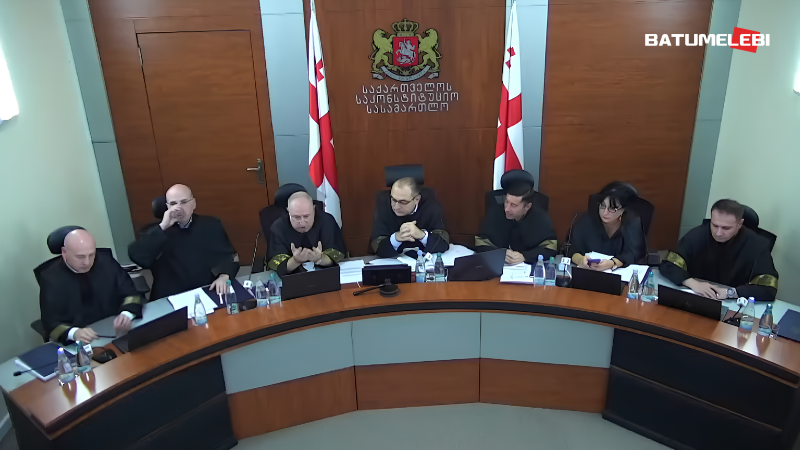
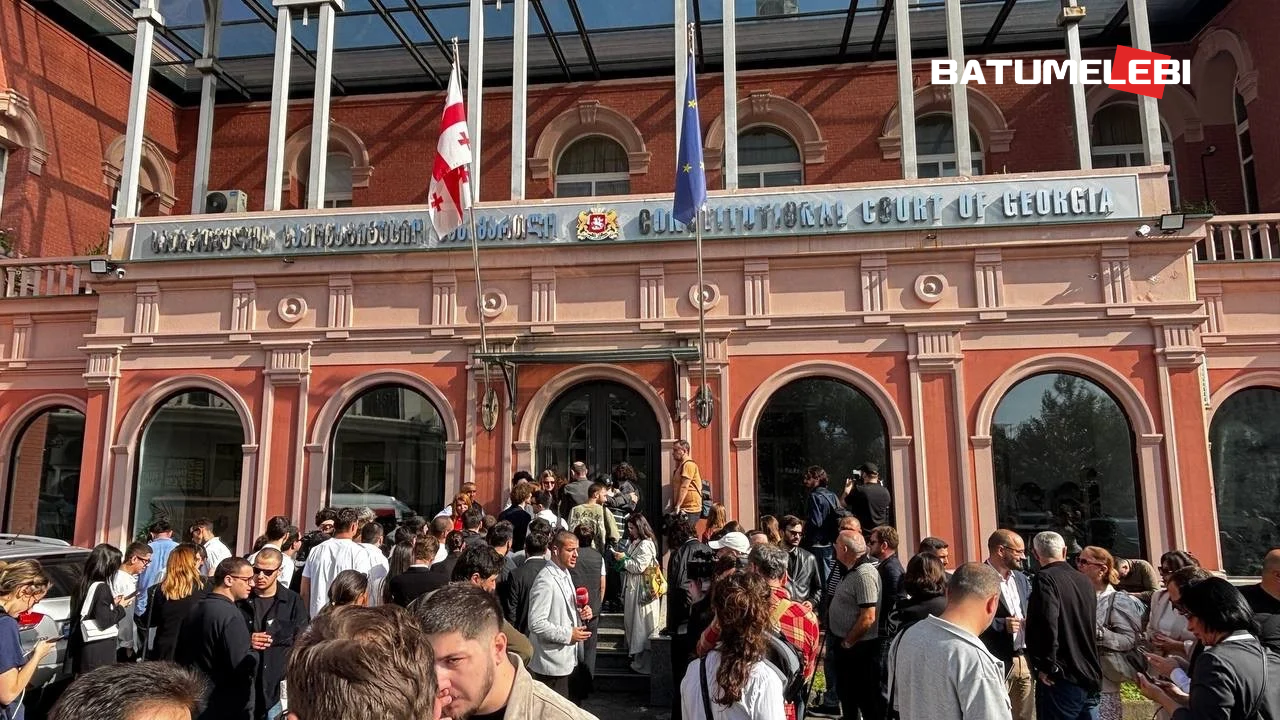
Veteran soldier and prisoner of conscience Anatoli Gigauri has been sentenced to two years in prison. The verdict was delivered by Judge Jvebe Nachkebia.
The judge altered the charges against Gigauri in the same way as in the case of conscience prisoner and journalist Mzia Amaglobeli, who was also sentenced to two years in prison.
Initially, Gigauri had been charged under Article 353¹ of Georgia’s Criminal Code – Attacking a police officer, an employee of the Special Penitentiary Service, or another representative of authority or a public institution – a crime punishable by four to seven years in prison. However, her final sentence was delivered under Part One of Article 353 – Resistance, threat, or violence against a protector of public order or other representative of the authorities – a lesser offense punishable by a fine, up to two years of house arrest, or two to six years’ imprisonment.
“Whatever verdict is delivered, we will face it with pride, with applause, and we will not allow evil to triumph over good,” Gigauri told his family members and supporters in the courtroom before the hearing began.
On the day of the verdict, he wore a T-shirt with a map of Georgia printed on it.
When Judge Nachkebia granted him the right to make his final statement, Gigauri briefly summarized the testimony of the witnesses brought forward by prosecutor Tamar Iakobidze.
“I want to use my final statement to draw attention to the kind of people the prosecutor brought as witnesses.
Let’s start with the first police officer – I asked him, in your presence, when my rights were being violated and I was asking for help, what were you doing? The man told me, ‘That’s not my business.’ So apparently, when human rights are violated, it’s not a police matter, but rather something for ‘other bodies’ to investigate – namely, crimes committed by police officers. That’s one.
The second police officer was made to say, here in front of you, that he had no physical contact with me – which doesn’t match the video evidence. He lied. Then a third officer was brought, who said the same – that he hadn’t touched me. Again, he lied – right in front of you and the video footage. Such people cannot be trusted.
Then came the investigator. He told you that Gigauri exercised his right to remain silent, and then, somehow five minutes later, claimed that I told him exactly how I was injured, what injuries I sustained, and how it happened – as it turns out he knew everything.
Another investigator was brought in, who proudly spoke here about carrying out some investigative actions – yet somehow missed the footage clearly showing a police officer striking me. This is our prosecution.
Then they brought the so-called ‘victim.’ Not a victim – an aggressor, a torturer. The man who tortured me, who struck me in the head with his fists while I was handcuffed, causing a concussion. And you tell me he’s the victim?
And after all this, we are expected to speak of justice? To say the word ‘justice’ and declare that he is the victim? I was attacked once, attacked again, third time, I was tortured – and have been held in prison for nine months – and now you want to talk to me about justice? Where is justice? Let’s see what kind of justice you deliver,” With these words, Anatoli Gigauri addressed Judge Nachkebia.
Anatoli Gigauri was arrested on November 25, 2024, while walking home from a protest rally.
In this case, the state prosecution is represented by prosecutor Tamar Iakobidze. The original charge carried a prison sentence of four to seven years. After reclassification, Judge Nachkebia imposed the harshest possible penalty — imprisonment — although the article also allows for a fine or house arrest.
The defense maintains that Gigauri’s intent was not to injure the police officer, and that he acted solely within the limits of necessary self-defense. Therefore, they argue, he should have been fully acquitted.
Gigauri acknowledges that he pushed police officer Vakhtang Gabunia but insists it was an act of self-defense. Video footage reviewed by the court shows that at the protest rally, Gabunia was the one who first punched Gigauri. According to Gigauri, the officer also insulted him at the moment of striking. Gigauri claims that Gabunia attempted to punch him a second time, prompting him to swing his arm in defense — a movement that touched the officer on the jacket, near the neck area.
Furthermore, Gigauri alleges that Gabunia assaulted him not only during the rally but also after his arrest, inside the police station. He says he was beaten at the moment of detention as well. According to his account, before taking him into the station, officers tried to stop his bleeding because they did not want to bring him inside covered in blood. Upon arriving at the station yard, they turned back, took him to a nearby pharmacy, purchased first-aid supplies, stopped the bleeding, and only then brought him back to the station.
The Prosecutor’s Office is investigating the allegations of police violence against Gigauri. However, no charges have yet been brought against any of the officers.
What is Happening in Georgia
In late fall 2024 and the beginning of winter, massive daily protests erupted across Georgia. The demonstrations were sparked by the ruling Georgian Dream party’s November 28 announcement to “postpone” the country’s EU integration bid until the end of 2028.
By that time, the ruling party had already been accused of massive electoral fraud during the October 26, 2024 parliamentary elections and of unconstitutionally forming a parliament boycotted by all opposition parties. The one-party parliament then proceeded to elect the government and appoint the president — all widely regarded as Georgian Dream-appointed, underscoring their perceived illegitimacy.
The protests, often referred to as the “Georgia Protests,” were met with violent crackdowns. Numerous journalists and citizens sustained physical injuries, and hundreds reported inhumane treatment at the hands of police and in detention, including cases amounting to torture. Journalists were attacked by uniformed, unidentified law enforcement officers during live broadcasts — none of which have been investigated.
Amidst police impunity and tightening repressive legislation, over 60 people have been jailed on criminal charges widely viewed as trumped-up and politically motivated attempts to silence dissent.
Since the late spring of 2025, eight opposition leaders were jailed for refusing to participate in a parliamentary commission purportedly formed to investigate crimes committed by the previous government, which left office in 2012. This commission has been widely criticized as a tool aimed at banning opposition parties. Notably, most opposition leaders summoned had never held high-ranking positions during the previous government’s rule, reinforcing suspicions that the commission’s true goal is to suppress the current opposition rather than investigate past crimes.
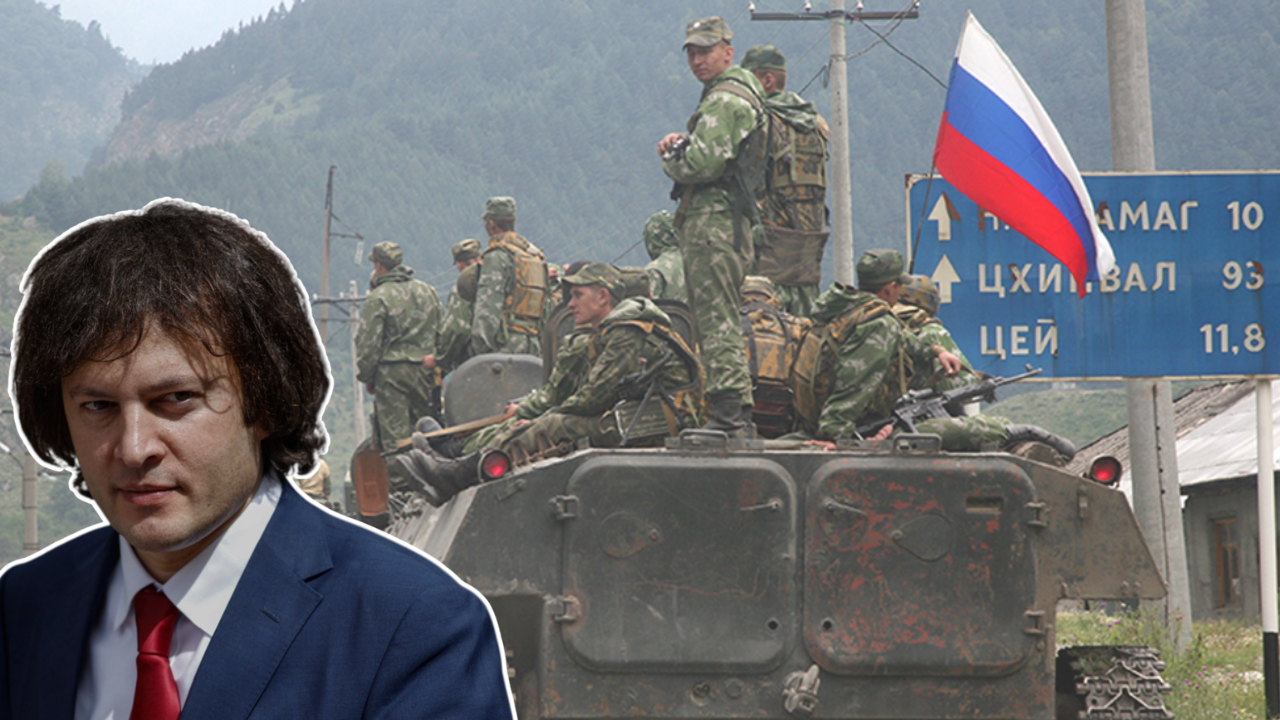
One of the main opposition figures, Giorgi Gakharia — who previously served as Interior Minister and Prime Minister under Georgian Dream — has been abroad “on an international business trip” since June, 2025. Meanwhile, an investigation is underway into his role in opening a checkpoint during his tenure as Interior Minister. The investigation involves criminal charges including sabotage, attempted sabotage under aggravating circumstances, aiding hostile activities on behalf of a foreign organization or one under foreign control, and mobilizing funds for actions directed against Georgia’s constitutional order and national security.
These are serious charges that carry potential prison sentences ranging from 7 to 15 years.
As trials of prisoners of conscience arrested during the pro-European protests continue, by August 12, eight individuals have been convicted and sentenced to imprisonment — all of whom pleaded not guilty. Among them is Mzia Amaglobeli, sentenced to two years in prison, making her the first female journalist to become a prisoner of conscience since Georgia regained its independence from the Soviet Union in 1991.
Two defendants pleaded guilty and sought plea deals but were nonetheless convicted and sentenced to prison without leniency. Only one defendant was acquitted and released in the courtroom.