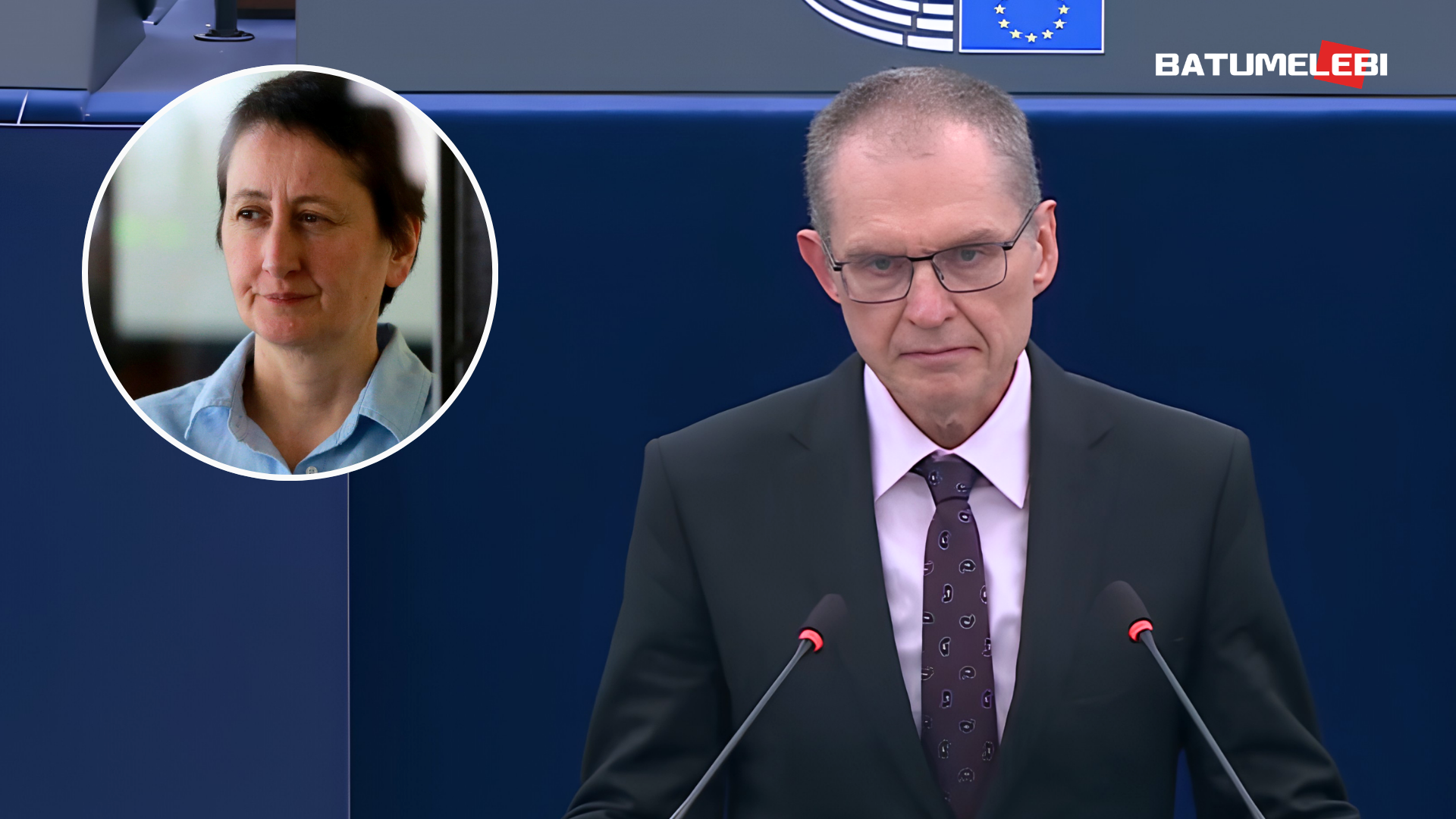
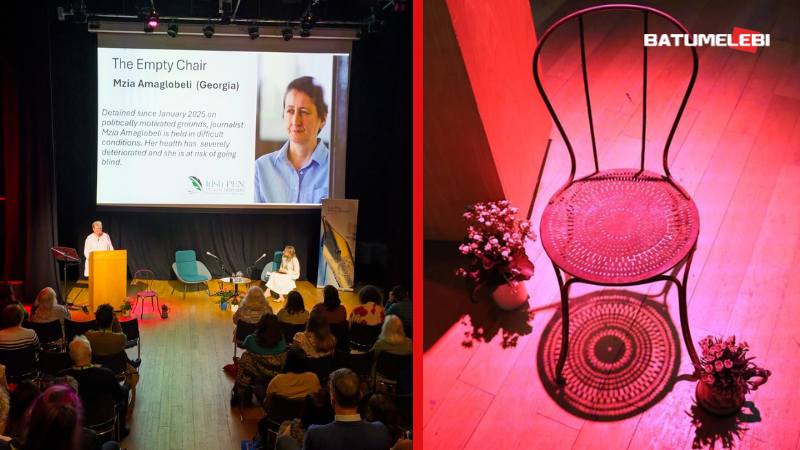
Mzia Amaglobeli, Georgia’s imprisoned journalist and Sakharov Prize laureate, founder of Netgazeti and Batumelebi, requested to speak at the Court of Appeals.
“I want to wish resilience and victory to the society in resistance. I want to thank the audience here in the courtroom, as well as my fellow supporters outside and my family, for not leaving me alone in this courtroom.
Unfortunately, I must speak again from a glass cell, though this is with the new composition of the court, as an accused… no, this time as a convict. I want to say that I cannot accept this status,” – Mzia Amaglobeli stated.
At this point, Judge Nikoloz Margvelashvili interrupted her speech and suggested that she leave the enclosed space. He addressed the penitentiary convoy unit, stating that if the protocol permitted, he would allow Mzia Amaglobeli to speak outside the enclosure. It should be noted that her defense team had repeatedly requested that city court judges permit Amaglobeli to speak from outside the glass cage, arguing that, as she had not been convicted, placing her there like a dangerous criminal violated her presumption of innocence and restricted her ability to fully participate in the hearing, communicate effectively with her lawyers, and have her voice heard in court. The motion was each time denied in both administrative and criminal case proceedings. For the first time, Amaglobeli was allowed to leave the glass cage, sit beside her lawyers, and continue her speech from there:
“Slapping is neither an attack nor resistance. Judge Nino Sakhelashvili sentenced me to imprisonment — she sent me to prison for two years. There is, perhaps, a group of people who believe I should be grateful for this sentence. Probably because they compare it to the prosecutor’s charges, which provide for imprisonment from four to seven years. I hope the number of such people is small. I want to tell them that this case has no connection to law or justice — neither to the qualification of the prosecutor’s charges nor to Judge Sakhelashvili’s verdict. My imprisonment is a political decision of the regime.”
Amaglobeli reminded the public that she has been in prison for ten months and that there has rarely been a week in which political figures in power, leaders of the ruling party, did not attack her from various television and propaganda outlets.
“It can not be much (help), but for every irresponsible comment containing allegations or false accusations, I have responded and will continue to respond legally with my lawyers, as long as they continue in this way.
Honestly, I think there is no greater evil than an unjust court. That is why we should not put up with it. I am here in this courtroom today precisely to appeal the Batumi City Court’s verdict and to demand a fair decision from the Court of Appeals.
You know better than I do, but I also think that the court should also reflect the will of society. From this perspective, when I think about the action for which I am here, and about what society might point to and judge me for, it is this: I couldn’t find within myself any repentance for slapping that man. He insulted me, spat on me, treated me inhumanely. To this day, I have not even been formally recognized as a victim. Even just formally, no statement has been made that the so-called victim, Dgebuadze, abused his official authority,” Mzia Amaglobeli said.
According to her, the investigation did nothing because the regime needs aggressors—it rewards and protects these aggressors so that they can carry out political and illegal orders.
“In this context, I don’t know whether the court will succeed in portraying me as a criminal, a dangerous criminal. I don’t think it will. Because the act on which this charge is based is a human, innate reaction — when you have an emotion triggered by insult and humiliation. Therefore, I believe that whether I spend two years or seven years in prison, this punishment will not serve as a deterrent. This imprisonment and punishment will not be able to carry any educational or corrective value, neither for me nor for any other citizen of Georgia.
I think this is something to reflect upon and deliberate.
In any case, I believe that if not today, then tomorrow, the criminal burden of my case will be lifted. I also believe that if not in my homeland, then in our larger family — the European family — where judges respect the supremacy of law, human rights, and freedom of expression (and I very much hope this will be the case in our country too), the European Court will deliver the just decision not only in my case but in the cases of all political prisoners,” Mzia Amaglobeli said.
November 11, the Court of Appeals in Kutaisi began reviewing Mzia Amaglobeli’s case. Next hearings for closing statement have been scheduled for November 14 and 18.