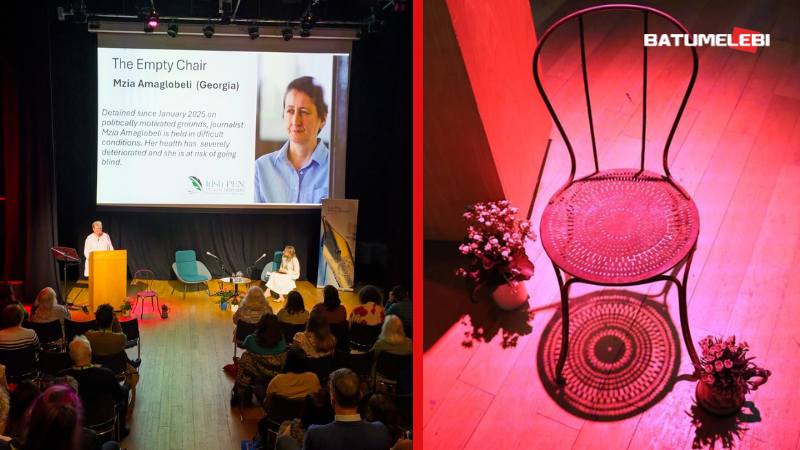
The European Court of Human Rights has registered a third application submitted on behalf of Mzia Amaglobeli, founder of Batumelebi&Netgazeti, concerning ill-treatment that took place on January 12, 2025.
The application was submitted by the Georgian Young Lawyers’ Association (GYLA). It was submitted on March 4, 2026, and the ECHR registered the case within one week, on March 11, 2026. GYLA was notified of the registration on April 1.
The European Court of Human Rights is already reviewing two cases concerning Mzia Amaglobeli.
The first case concerns the unlawful use of detention against her as a preventive measure, for which GYLA has already submitted a written response challenging the state’s position.
The second case, relating to Amaglobeli’s administrative detention and associated violations, has also been registered by the European Court.
In relation to the third application, GYLA describes the events as follows:
“On January 12, 2025, around 1 a.m., police at the entrance of the Adjara Police Department unlawfully and violently detained Mzia Amaglobeli, causing her physical injuries and tearing her jacket. Upon being brought into the police compound, the Batumi Police Chief, Irakli Dgebuadze, verbally insulted her, cursed at her, and threatened her with arrest under criminal code. He also attempted physical violence against Mzia in the police compound, but officers restrained him.
The ill-treatment continued inside the police department. Additionally, Mzia Amaglobeli was denied access to a lawyer for several hours, searched without the presence of her attorneys, and had handcuffs applied behind her back in a humiliating manner, although there was no justification for this.”
In the third complaint filed with the European Court, GYLA argues that Mzia Amaglobeli’s fundamental rights under the Convention were violated, including:
Article 3 (substantive) — prohibition of torture and inhuman or degrading treatment, in conjunction with Article 14 — prohibition of discrimination
Article 3 (procedural) — ineffective investigation
Article 8 — right to respect for private and family life, in conjunction with Article 14
Article 13 — right to an effective remedy, in conjunction with Article 3
GYLA explains:
“Degrading treatment (Article 3 substantive, in conjunction with Article 14): Unjustified use of physical force by police, causing injuries, spitting in her face, denying water and toilet access, and severe verbal abuse on gender grounds constituted degrading treatment. These acts aimed to humiliate Mzia Amaglobeli for discriminatory reasons.
Ineffective investigation (Article 3 procedural): The state failed to ensure an independent and objective investigation of the ill-treatment. For example, investigators only reviewed video footage from one police entrance, which did not show Mzia being brought inside.
The investigation’s ineffectiveness is further highlighted by the Ministry of Internal Affairs’ public safety management center (“112”) replying that requested footage of the building perimeter for the relevant period was unavailable.
The investigation also failed to request documentation from Batumi City Hall showing that external surveillance cameras covering the entrance and courtyard were installed only after January 11, 2025.
It did not examine the reasons and actual circumstances behind the violation of Amaglobeli’s right to legal defense, and one expert report remains unreviewed.
False testimonies by police officers were left unaddressed. For example, Irakli Dgebuadze claimed he remained at the protest after detention, but footage shows him accompanying and verbally abusing her in the courtyard. Officers Berdia Peradze and Giorgi Bzhalava falsely claimed to have participated in the arrest, while footage shows Bzhalava was not involved. The investigation also failed to identify or question actual officers who witnessed the ill-treatment.
Despite Dgebuadze admitting at trial that he verbally abused Mzia Amaglobeli, she has not been recognized as a victim.
Violation of privacy and family life (Article 8, in conjunction with Article 14): Searches conducted without a lawyer and handcuffing her behind her back without any security risk constituted an unjustified and disproportionate interference with her privacy. These measures were applied solely to humiliate her, in a cynical and gender-discriminatory manner, exceeding legal boundaries.
Right to an effective remedy (Article 13, in conjunction with Article 3): There is no effective mechanism in Georgia for a person to obtain victim status. After the Special Investigation Service was dissolved, the case was transferred to the Adjara Prosecutor’s Office, revealing flawed practices.
Specifically, the prosecutor’s office failed to respond in writing to requests for victim status, and the courts, adopting a formalistic approach, refused to consider complaints, claiming no written denial from the prosecution existed. This left Mzia Amaglobeli without real means of protection, making it impossible to remedy the violated rights at the national level.”
Mzia Amaglobeli was prosecuted in the Batumi City Court for slapping Batumi Police Chief Irakli Dgebuadze. On August 6, 2025, Judge Nino Sakhelashvili sentenced her to two years of imprisonment.
The Kutaisi Court of Appeal upheld the verdict. The decision was made by three judges: Nikoloz Margvelashvili, Marina Siradze, and Nana Jokhadze. The Supreme Court did not review Amaglobeli’s appeal.
This decision was taken by the three judges of the Supreme Court’s Criminal Chamber: Levan Tevzadze, Merab Gabinashvili, and Mamuka Vasadze.