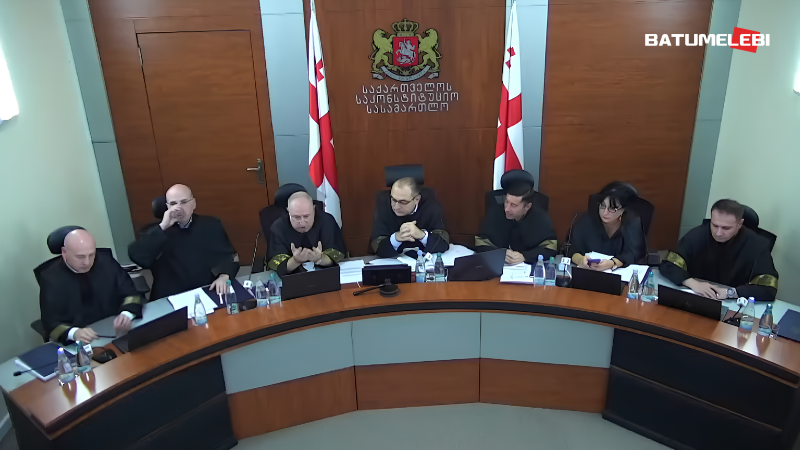
The “Georgian Dream” parliament has passed another set of repressive legislative amendments at first reading.
Under the amendments, the definition of a “grant” is further defined and significantly expanded, placing virtually any form of political self-expression by an individual under state control and criminalizing it if the individual receives resources from a citizen or a legal entity of another state. In particular:
- Amendments to the Law “On Grants” specify the definition of a grant and establish that a grant also includes funds transferred in monetary or in-kind form by a foreign citizen, or a foreign legal entity to a citizen of Georgia, a person holding a residence permit in Georgia, or a legal entity whose activities are substantially related to issues concerning Georgia, where such funds are intended or may be intended to influence the Georgian authorities, state institutions, or any part of society, with the belief or intent to shape, implement, or change Georgia’s domestic or foreign policy, or where the activity derives from the political or public interests, approaches, or relations of a foreign state or foreign political party. Receipt of such a grant will be permitted only with prior approval of the Government of Georgia.
- The law introduces a definition of a legal entity of another state whose activities substantially involve engagement with issues related to Georgia. Such a legal entity will be permitted to receive a grant only after obtaining prior consent from the Government of Georgia. For example, an organization registered abroad but whose activities are substantially carried out in Georgia will be required to apply to the Georgian government in order to receive funding. Failure to do so will result in criminal liability.
- The definition of a grant is further clarified to include funds transferred in monetary or in-kind form in exchange for technical assistance, including the transfer of technologies, specialized knowledge, skills, expertise, services, or other forms of assistance. Accordingly, if a “foreign power” hires experts in Georgia in exchange for payment, such funds will be considered a grant and will require the prior consent of the Government of Georgia.
- If a representative office, branch, or subdivision of a non-resident legal entity receives a grant (including from its parent organization), it must obtain prior government consent. The draft law stipulates that receipt of a grant by such a branch without consent will result in administrative liability, in the form of a fine amounting to double the value of the unlawfully received grant
According to the proposed amendments to the Criminal Code:
- Violation of the rules established under the Law “On Grants” will give rise to criminal liability. Such a violation will be punishable by a fine, community service of 300 to 500 hours, or imprisonment for up to six years.
- Article 194 (money laundering) is supplemented with an aggravating circumstance: laundering money for the purpose of political activity related to Georgia will be punishable by 9 to 12 years’ imprisonment
- Criminal liability is introduced for senior officials of political parties who violate the Organic Law “On Political Unions of Citizens” by accepting foreign funding, punishable by a fine, community service (300–500 hours), or imprisonment for up to 6 years;
- External lobbying becomes a criminal offense: providing money, securities, property, material benefit, or any advantage (directly or indirectly) to a foreign citizen or legal entity in exchange for political activity related to Georgia will be punishable by a fine, community service (300–500 hours), or imprisonment for up to 6 years.
Amendments to the Organic Law “On Political Unions of Citizens”:
- A person employed under a labor contract by an organization that receives more than 20% of its annual income from a foreign power is prohibited from being a member of a political party for 8 years;
- The term “entity with a declared electoral objective” is replaced by “entity with a declared party-political objective,” clarifying and expanding the scope of regulation;
- Financial monitoring of entities with declared party-political objectives will be conducted by the State Audit Office; Restrictions applicable to political parties will also apply to such entities. The legal package also envisages the amendments to the Code of Administrative Offences: a new administrative offense is introduced for entrepreneurial entities engaging in public political activity unrelated to their core business activities. Financial monitoring of entities with declared party-political objectives will be conducted by the State Audit Office; Restrictions applicable to political parties will also apply to such entities.
The legal package also envisages the amendments to the Code of Administrative Offences: a new administrative offense is introduced for entrepreneurial entities engaging in public political activity unrelated to their core business activities. The penalties envisaged for the hereof administrative offense to be imposed by the State Audit Office on the entrepreneurs are: 20,000 GEL for a first violation, and 40,000 GEL for repeated or subsequent violations.