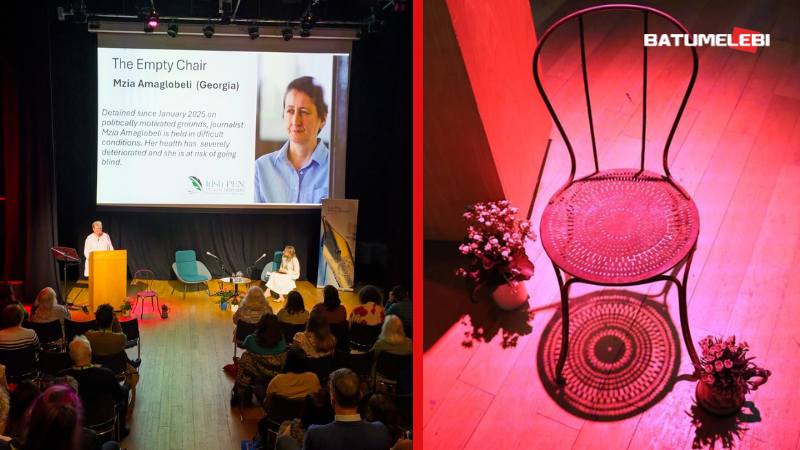
For nearly a year, journalist Mzia Amaglobeli has remained behind bars, serving a two-year sentence for a single slap—an imprisonment widely regarded as politically motivated and unlawful.
On 16 December 2025, she was awarded the Sakharov Prize, the European Union’s highest human rights honor. In addition to honoring Amaglobeli’s personal sacrifice and the broader struggle of the Georgian people, the award highlights mounting international alarm over Georgia’s slide toward authoritarianism—a process in which the judiciary plays a pivotal role.
- This article profiles the 12 judges responsible for Amaglobeli’s imprisonment, exploring their backgrounds and assets.
Their rulings reflect the Georgian Dream party’s efforts to stifle dissent and suppress protest, while Amaglobeli has emerged as a symbol of ongoing resistance.
Mzia Amaglobeli, an award-winning journalist and co-founder of the independent media outlets Batumelebi and Netgazeti, is the first female journalist in Georgia to be jailed for political reasons since the country gained independence from the Soviet Union.
At the court of first instance, Mzia Amaglobeli was sentenced to two years in prison by Judge Nino Sakhelashvili. On appeal, the presiding judge, Nikoloz Margvelashvili, and two other judges upheld the verdict.
- Nikoloz Margvelashvili: The Appellate Judge Who Upheld the Unlawful Verdict
On November 18, 2025, the Kutaisi Court of Appeal upheld the Batumi City Court’s verdict against Mzia Amaglobeli.
The appellate panel consisted of the presiding judge, Nikoloz Margvelashvili, and the judges Marina Siradze and Nana Jokhadze. Amaglobeli’s legal team appealed for her acquittal and release, but the prosecution sought an even harsher sentence—four to seven years in prison, rather than two.
Before joining the Kutaisi Court of Appeal, Margvelashvili served as Chair of the Kutaisi City Court beginning in 2019. Appointed to a lifetime judgeship in 2018, he started his judicial career at the Tbilisi City Court in 2016.
In 2020, Margvelashvili received a 143.49-square-meter house in Kutaisi as a gift. He bought an apartment in Tbilisi for USD 60,000 in 2017 and, in 2024, purchased a BMW X6 for USD 22,000.
In 2024, Margvelashvili served as Chair of the Kutaisi Court of Appeal, earning an annual salary of GEL 105,064. His wife, Tamar Doghonadze, was employed at the Special Investigation Service the same year.
Georgian civil society organizations and diaspora groups are collaborating with foreign ministries in multiple countries to advocate for sanctions against all judges involved in the Mzia Amaglobeli case.
- Marina Siradze: From Krasnoyarsk Inspector to Longtime Appellate Judge
Marina Siradze, another judge of the Kutaisi Court of Appeal who upheld the verdict in the Amaglobeli case, previously served as a senior inspector in the information department of the Krasnoyarsk Regional Directorate of the Soviet Interior Ministry from 1982 to 1991.
She earned her law degree from Krasnoyarsk State University in 1992.
Siradze has served as a judge since 1999, beginning at the Kutaisi Regional Court. For the past two decades, she has been an appellate judge at the Kutaisi Court of Appeal. Between 2009 and 2012, she also served at the Kharagauli District Court and, during that time, continued to exercise judicial authority at the Court of Appeal.
She has held a lifetime judicial appointment since October 2019, a position she will retain until reaching the statutory retirement age.
According to her asset declaration, Siradze owns three apartments: one in Tbilisi, purchased in 2024 for USD 66,000, another in Tbilisi, bought in 2015 for GEL 45,000, and one in Kutaisi, acquired in 2003 for GEL 25,000.
In 2024, her salary totaled GEL 104,344.
Georgian civil society organizations and diaspora groups are collaborating with foreign ministries in multiple countries to advocate for sanctions against all judges involved in the Mzia Amaglobeli case.
- Nana Jokhadze: Judge Linked to US-Sanctioned Judicial Clan
Judge Nana Jokhadze also reviewed Mzia Amaglobeli’s case at the Kutaisi Court of Appeal, ultimately upholding her conviction.
In 2023, Jokhadze publicly expressed support for a group of judges widely referred to as a ‘judicial clan.’ She declined an invitation to the United States for a study visit when the US imposed sanctions on three sitting Georgian judges—Levan Murusidze, Mikheil Chinchaladze, and Irakli Shengelia—as well as former judge Valerian Tsertsvadze.
Since 2024, Jokhadze has served as a judge at the Kutaisi Court of Appeal, following her tenure at the Kutaisi City Court from 2021 to 2024. Appointed for life in 2019, she has made no significant property acquisitions, according to her asset declarations.
Georgian civil society organizations and diaspora groups are collaborating with foreign ministries in multiple countries to advocate for sanctions against all judges involved in the Mzia Amaglobeli case.
- Nino Sakhelashvili: Judge Who Unlawfully Sentenced Mzia Amaglobeli to Prison
On 6 August 2025, Judge Nino Sakhelashvili of Batumi City Court sentenced journalist Mzia Amaglobeli to two years in prison. Her verdict, widely considered unlawful, omitted and disregarded key evidence presented during the trial.
Throughout the seven-month substantive hearing, Sakhelashvili kept Mzia Amaglobeli in pretrial detention, employing the harshest preventive measure without legal justification, according to Amaglobeli’s lawyers.
On 14 January 2025, while still serving her probationary period, Judge Sakhelashvili ordered Amaglobeli’s detention. Despite lacking qualifications in criminal law, Sakhelashvili was subsequently appointed as a lifetime judge after Amaglobeli’s arrest.

Sakhelashvili later became the subject of international sanctions. On 3 March 2025, Estonia sanctioned her specifically for her role in the Amaglobeli case, citing violations of her rights as a journalist.
In 2022, Sakhelashvili purchased an apartment in Tbilisi for USD 55,000, owns five plots of land in Tkibuli received as gifts, and acquired a Ford C-Max in 2021 for USD 5,270.
In 2024, her salary was GEL 95,271 (GEL 7,939 per month).
Georgian civil society organizations and diaspora groups are collaborating with foreign ministries in multiple countries to advocate for sanctions against all judges involved in the Mzia Amaglobeli case.
- Viktor Metreveli: Judge Who Denied Mzia Amaglobeli a Fair Defense
Judge Viktor Metreveli severely undermined Mzia Amaglobeli’s right to a defense.
During the pretrial hearing on 4 March 2025, he excluded the majority of the evidence, including 17 witnesses, 18 video files, 13 inspection reports, and 14 written documents.
According to human rights advocates, these actions stripped Amaglobeli of her right to defense and failed to ensure even the most basic procedural guarantees of a fair trial.
Metreveli also ordered the continuation of her unlawful detention.
Notably, during that hearing, the prosecution argued that Amaglobeli should remain in custody to “prevent the risk of committing a new offense,” referencing her prior administrative detention as justification. However, this detention—stemming from the sticker incident—was fabricated, as evidenced by continuous video footage from the 11 January 2025 protest.

Appointed as a judge in 2024, Metreveli previously held various roles within the Tbilisi City and Appellate Court administrations.
His asset declaration reports no significant property holdings.
Georgian civil society organizations and diaspora groups are collaborating with foreign ministries in multiple countries to advocate for sanctions against all judges involved in the Mzia Amaglobeli case.
- Salikh Shainidze: Judge Who Turned a Blind Eye to Police Fabrication
Judge Salikh Shainidze fined Mzia Amaglobeli for placing a sticker on the fence of the police department building.
Despite clear evidence in court that senior police officials fabricated the case, on 18 March 2025, Shainidze imposed a GEL 2,000 fine on Amaglobeli.
On 11 January 2025, before her criminal arrest, Amaglobeli was administratively detained for placing a sticker reading “Georgia on Strike.” Another activist, Tsiala Katamidze, was also detained for the same action and fined GEL 2,000 by Shainidze.
Why Is the “Mzia Amaglobeli Case” Considered Fabricated? At the 13 March administrative hearing, Judge Salikh Shainidze confirmed the facts presented by Amaglobeli’s lawyers, including a video proving that Grigol Beselia, the Head of the Adjara Police Department, personally detained Amaglobeli. However, the official report falsely claimed that another officer, Gocha Vanadze, performed the arrest.
Judge Shainidze also deemed the video evidence capturing Irakli Dgebuadze, Head of the Batumi Police, indisputable and stated that Amaglobeli was detained under Article 150 of the Administrative Offences Code. In contrast, the fabricated report asserted she was detained under Article 173, which concerns insulting police officers and disobeying a lawful order.

The Ministry of Internal Affairs became so entangled in fabricating Amaglobeli’s administrative case that, with the judge’s complicity, Amaglobeli was ultimately fined twice for the same act—placing a sticker. The second fine followed after Amaglobeli’s lawyers exposed Grigol Beselia’s false testimony; he alleged that the Ministry of Internal Affairs was also accusing Amaglobeli of placing a sticker on the police fence, even though no such report existed when he testified before the Batumi City Court on 28 April 2025.
Two days later, an additional report was filed against Mzia Amaglobeli for the same sticker incident.
According to asset declarations, there is no information indicating any significant property acquisitions by this judge.
Georgian civil society organizations and diaspora groups are collaborating with foreign ministries in multiple countries to advocate for sanctions against all judges involved in the Mzia Amaglobeli case.
- Mariana Fomaeva: Judge Who Retried Mzia Amaglobeli for the Same Act
Judge Mariana Fomaeva presided over a retrial of Mzia Amaglobeli for the same act—placing a sticker on the fence of the Adjara Police Department building.
Prosecuting an individual twice for the same act is prohibited by law.
The Georgian Dream court pursued a retrial of Mzia Amaglobeli after her lawyers exposed false testimony by Grigol Beselia, the former head of the Adjara Police Department, during the 28 April 2025 hearing. Beselia claimed that the Ministry of Internal Affairs was also charging Amaglobeli for placing a sticker on the Ministry’s fence. However, no such report existed at the time of his testimony.
Before Beselia’s testimony, Amaglobeli was prosecuted for allegedly insulting police officers, with authorities claiming she was detained for calling officers “Russians” and “slaves.” The police fabricated this narrative, as uninterrupted video footage clearly shows Grigol Beselia detaining Amaglobeli at the moment she placed the sticker. The same footage also captures Irakli Dgebuadze, Head of the Batumi Police, stating she was detained under Article 150 of the Administrative Offences Code.
Notably, Article 150 of the Administrative Offences Code does not authorize detention.
As a result, Amaglobeli was prosecuted under Article 173, which concerns insulting police officers. When the falsification became evident during the criminal proceedings—further confirmed by Beselia’s testimony—a new administrative report was filed against Amaglobeli by the Ministry of Internal Affairs. This report, dated 30 April 2025, pertained to the sticker incident on 11 January.
Judge Mariana Fomaeva fined Amaglobeli 1,000 GEL for this incident.
In March 2025, Judge Fomaeva fined participants of a pro-European rally in Batumi 5,000 GEL each, following accusations by the Ministry of Internal Affairs that they had artificially created a barrier at a pedestrian crosswalk.
According to asset declarations, Judge Fomaeva has not reported any significant property acquisitions.
Georgian civil society organizations and diaspora groups are collaborating with foreign ministries in multiple countries to advocate for sanctions against all judges involved in the Mzia Amaglobeli case.
- Zaza Ramishvili: Judge Who Rejected Mzia Amaglobeli’s Appeal After She Was Tried Twice for Placing a Sticker
Judge Zaza Ramishvili deliberated and upheld the decision of Batumi City Court Judge Mariana Fomaeva, finding Mzia Amaglobeli guilty of an act described under Article 150 of the Administrative Offences Code.
“Essentially, the appellate court stated that any action related to a person’s constitutional rights—such as freedom of expression or expressing one’s views—and conducted harmlessly, like placing a sticker, constitutes an administrative offense,” explained Mzia Amaglobeli’s lawyer Giorgi Khimshiashvili in an interview with Batumelebi on 9 September 2025.
Zaza Ramishvili has served as a judge at the Kutaisi Court of Appeal since 2023 and holds a lifetime appointment.
Ramishvili also served as the reporting judge in an election dispute brought by the Georgian Young Lawyers’ Association (GYLA), which challenged violations of ballot secrecy after the 2024 parliamentary elections.
According to his asset declaration, Judge Ramishvili has not reported any significant property acquisitions.
In 2024, Judge Ramishvili adjudicated an election dispute alongside Shota Siradze, Vazha Siradze’s father, who is one of Georgia’s influential police officials.
Judge Shota Siradze was also involved in reviewing Mzia Amaglobeli’s case.
How Was Mzia Amaglobeli Tried Twice? At a protest rally on 11 January 2025, Mzia Amaglobeli placed a sticker reading “Georgia Swears” on an auxiliary structure at the entrance to the Ministry of Internal Affairs’ police department. Although police officers lacked legal authority to detain her for this act, they proceeded to do so, later alleging that Amaglobeli insulted and verbally abused them. Despite the case’s fabricated nature, on 18 March, Judge Salikh Shainidze found Amaglobeli guilty of an administrative offense and fined her GEL 2,000.
Georgian civil society organizations and diaspora groups are collaborating with foreign ministries in multiple countries to advocate for sanctions against all judges involved in the Mzia Amaglobeli case.
- Shota Siradze: Judge Who Overlooked Manipulation of Video Evidence; His Son Is a Senior Ministry Official
In June 2025, Judge Shota Siradze dismissed Mzia Amaglobeli’s appeal for release from detention.
Amaglobeli’s lawyers presented expert opinions from both French and Georgian specialists, confirming that police manipulated evidence and video footage. The court’s rationale for disregarding these expert conclusions remains unknown to the defense.
Experts concluded that the Ministry of Internal Affairs manipulated video evidence in Amaglobeli’s administrative case.
Siradze refused the appeal without even scheduling an oral hearing, denying both parties an opportunity to present arguments in court.
Siradze is the father of Vazha Siradze, former head of the Patrol Police and current head of the Tbilisi Police. In 2024, Vazha Siradze was sanctioned by Czechia, Latvia, Lithuania, and Estonia for his role during protest rallies.
According to his 2025 declaration, Judge Siradze purchased a car for USD 23,000 in 2024, while his wife, Eka Lataria, bought a car for USD 24,000 in 2023.
Siradze also owns a watercraft, having purchased a Hurricane in 2024 for USD 8,000.
Judge Siradze’s monthly salary is approximately GEL 8,737. His wife, a lawyer also involved in business, earned GEL 175,000 in 2024.
Georgian civil society organizations and diaspora groups are collaborating with foreign ministries in multiple countries to advocate for sanctions against all judges involved in the Mzia Amaglobeli case.
- Malkhaz Okropirashvili: Judge Who Refused to Review the Complaint of Hunger-Striking Journalist
On 21 January 2025, Malkhaz Okropirashvili declared inadmissible the complaint submitted by Mzia Amaglobeli’s lawyers, who appealed Judge Nino Sakhelashvili’s decision to detain Amaglobeli while she was on hunger strike.
In 2025, Judge Okropirashvili was sanctioned by Estonia and Lithuania for his role in the “Mzia Amaglobeli case.”
On 24 January 2025, citizens protested outside Judge Okropirashvili’s residence, objecting to his refusal to consider the complaint of the hunger-striking journalist. As a result, musician Nino Katamadze, psychologist Maia Tsiramua, journalist Gela Mtivlishvili, teacher and national award recipient Lado Apkhozava, and journalists Khvicha Vashakmadze, Ketevan Pilaouri, Eka Kukhalashvili, Irma Zarandia, and Givi Tsintsadze were all found to have committed administrative offenses by Judge Tsitsino Mosidze and fined GEL 5,000 each.
Okropirashvili has served as a judge since 2005 and was appointed for life in 2018. In 2024, he received a salary of GEL 109,000.
Georgian civil society organizations and diaspora groups are collaborating with foreign ministries in multiple countries to advocate for sanctions against all judges involved in the Mzia Amaglobeli case.
- Vera Dolidze: Judge Accused by “Georgian Dream” of Issuing Unlawful Decisions Under UNM and Later Promoted
Vera Dolidze, a judge at the Kutaisi Court of Appeal, refused to review the unlawful detention of Mzia Amaglobeli, despite clear evidence of fabrication by the Ministry of Internal Affairs in the case.
Amaglobeli’s lawyers appealed to Judge Vera Dolidze after Judge Levan Kolbaia of the Batumi City Court declared inadmissible their 14 February 2025 motion to change the measure of restraint. By that stage, the defense had already identified multiple circumstances confirming that the case against Amaglobeli was fabricated.
From 2009 to 2012, Dolidze served as a judge at the Batumi City Court. Since 2012, she has been a judge in the Criminal Chamber of the Kutaisi Court of Appeal.
One notable case from Dolidze’s tenure at the Batumi City Court occurred in 2011, when she imposed pretrial detention on 23-year-old student Tsotne Ananidze, who was accused of resisting police and attempting to seize Adjara Television. The “Georgian Dream” government later deemed Ananidze’s detention unlawful, including him on the list of political prisoners. Today, Ananidze serves as a “Georgian Dream” MP in the Supreme Council of Adjara.
According to “Georgian Dream,” Dolidze issued an unlawful decision, yet was subsequently promoted to a higher court, becoming a judge at the Kutaisi Court of Appeal in 2012.
Vera Dolidze purchased an apartment in Batumi in 2019 for USD 49,500 on Sherif Khimshiashvili Street, and an 80 sq. m. apartment in Tbilisi in 2014 for USD 70,000.
Dolidze’s husband, Genadi Kuchukhidze, serves as Deputy Head of the Administrative Service of Kutaisi City Hall. He purchased a 101 sq. m. apartment in Kutaisi in 2021 for GEL 135,000. In 2024, his monthly salary was GEL 2,475, while Dolidze’s was GEL 8,695.
Georgian civil society organizations and diaspora groups are collaborating with foreign ministries in multiple countries to advocate for sanctions against all judges involved in the Mzia Amaglobeli case.
- Levan Kolbaia: Another Judge Who Overlooked a Fabricated Case
On 14 February 2025, Judge Levan Kolbaia declared inadmissible the motion filed by Mzia Amaglobeli’s lawyers seeking to lift the preventive measure of detention.
Amaglobeli’s lawyers presented several circumstances to Judge Kolbaia that should have warranted her release, most notably the fabricated administrative detention report. Prosecutors Vladimer Turmanidze and Tornike Gogeshvili, in seeking the preventive measure on 14 January 2025, relied on this same falsified report to justify Amaglobeli’s imprisonment. Judge Nino Sakhelashvili also referenced the document, which stated that Amaglobeli was detained for insulting police officers (Article 173 of the Administrative Offences Code). However, video evidence recorded by Batumelebi confirmed the case was fabricated: Amaglobeli was actually detained under Article 150 (placing a sticker), by Grigol Beselia, Head of the Adjara Police Department.
Levan Kolbaia has served as a judge since 2021. Previously, he worked with the Government of Abkhazia and, from 2010 to 2013, was Deputy Chair of the NGO “For the Support of IDPs.”
In 2024, Kolbaia’s salary totaled GEL 95,271 (GEL 7,940 per month).
In 2024, Kolbaia purchased a house in Tbilisi (50% co-ownership) for GEL 303,000.
Georgian civil society organizations and diaspora groups are collaborating with foreign ministries in multiple countries to advocate for sanctions against all judges involved in the Mzia Amaglobeli case.