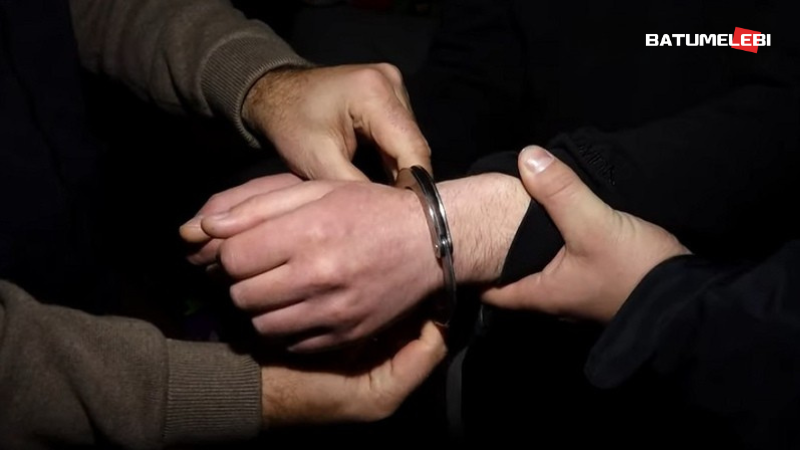
On February 18, police in Tbilisi detained Eliso Kiladze, the founder and editor-in-chief of Qronika+. It later emerged that the journalist had been arrested in connection with a so-called fraudulent call center case.
According to the Prosecutor’s Office, Kiladze has been charged alongside several other individuals, including former Chief Prosecutor Otar Partskhaladze, brothers David and Giorgi Mikadzes (who are accused in the murder of Merab Jangveladz) and others. Eliso Kiladze faces charges under Articles 180 and 194 of Georgia’s Criminal Code, punishable by 9 to 12 years in prison.
For years, Kiladze frequently published information related to high-profile cases, claiming that her reporting was based on insider sources.
Kiladze denies the charges. In a letter published by CNews, a news agency founded by Qrokika+, she wrote that her arrest is linked to attempts to conceal “new details of a new case.” She also stated that this week she plans to speak publicly about the suicides of Soso Tsakadze, director of Gldani Prison and an employee of the State Security Service (SSG).
The Prosecutor’s Office Statement
“Criminal prosecution has been initiated against ten individuals on charges of fraud and money laundering committed by an organized group.
Charges have been brought in absentia against former Chief Prosecutor of Georgia Otar Partskhaladze, who is in hiding, as well as against members of his criminal group: David Mikadze, Irakli Sekhniashvili, and Mikheil Chokheli. The indictment will be formally served on Giorgi Mikadze, who is currently placed in a penitentiary institution in connection with another criminal case.
Within the framework of the same criminal case, a member of the organized criminal group, Eliso Kiladze, has been detained. Charges will also be brought against other members of the group — Givi Jibladze, Ben Anor, Tornike Janelidze, and Giorgi Kamladze — who cooperated with the investigation and not only admitted the crime committed but also substantially assisted in uncovering the transnational crime.
We remind the public that, as stated at a previous briefing, during 2020–2023, despite the state’s declared legal fight in this direction, several dozen fraudulent call centers were still operating in the country.
According to witness testimony, the vast majority of these call centers belonged to a group of individuals who financed various opposition media outlets from the proceeds received. A relatively smaller portion of the call centers was protected by Grigol Liluashvili and Otar Partskhaladze through members of their close circle.
The joint investigation conducted by the Prosecutor’s Office of Georgia and the Investigative Service of the Ministry of Finance established that during 2020–2023, an organized criminal group with an agreed structure and coordinated actions operated in Georgia under the protection of Otar Partskhaladze. Its purpose was to obtain material benefit unlawfully and subsequently launder the money.
Members of the organized group established several legal entities in Georgia, on the basis of which they set up fraudulent call centers in various locations in Tbilisi, with Russian-language, English-language, and German-language divisions.
Operators of the call centers, acting on instructions from managers, attracted customers to fake trading platforms, involved them in trading by promising profitable investments, and fraudulently took possession of large sums of money and cryptocurrency invested by the customers. Thereafter, they carried out the placement, layering, and integration of the illegal assets.
The functions of the organized group members included ensuring the proper operation and functioning of the criminal call centers; protecting the call centers’ illegal activities from law enforcement and other competing organizations; providing informational support in case of exposure; and, as necessary, ensuring the dismantling of the activities of so-called “disobedient competitors.”
In particular, Givi Jibladze, Ben Anor, Tornike Janelidze, and Giorgi Kamlade ensured the proper functioning of the call centers, made decisions regarding expansion or relocation, exercised active supervision over operational processes, kept records of revenues and expenses, issued salaries and bonuses, and calculated and distributed funds to partners and protectors.
Other members of the organized group — Giorgi Mikadze, David Mikadze, Irakli Sekhniashvili, and Mikheil Chokheli — through Otar Partskhaladze and his influence, ensured the protection of the criminal activities of the call centers, which included shielding them from interference by law enforcement and competing organizations. They also participated in the decision-making process regarding important matters necessary for the functioning of the call centers.
It should be noted that in the event of exposure of the call centers’ activities, or the existence of such risk, Eliso Kiladze ensured that the criminal activities were portrayed as lawful by disseminating relevant information on various media platforms. At the same time, for the purpose of exposing competing call centers that were not under their influence, Eliso Kiladze planned, threatened, or carried out the public dissemination of information regarding their locations and employees, and subsequently created appropriate conditions for their recruitment through blackmail.
For the services rendered, the influence and informational protectors received substantial monthly benefits from funds fraudulently obtained from non-resident individuals.
At this stage, the investigation has established that during 2020–2023, within the framework of the criminal activity, members of the organized group fraudulently took possession of cryptocurrency worth approximately 9.5 million US dollars belonging to more than 200 foreign citizens. For the purpose of legalizing the illegal income, the virtual assets fraudulently obtained from victims were fragmented and distributed through multiple transactions across various crypto wallets controlled by members of the organized group.
The cash obtained as a result of converting the virtual assets was used to cover the needs of the organized criminal group, including the payment of salaries and bonuses and the operating expenses of the call centers. Additionally, funds accumulated through criminal activity were used by group members, as though legally obtained income, to purchase movable and immovable property.
The charges brought under Articles 180 and 194 of the Criminal Code of Georgia against Otar Partskhaladze, Giorgi Mikadze, David Mikadze, Irakli Sekhniashvili, Mikheil Chokheli, Eliso Kiladze, Givi Jibladze, Ben Anor, Tornike Janelidze, and Giorgi Kamlade envisage a sentence of imprisonment from 9 to 12 years.
The Prosecutor’s Office of Georgia will apply to the court within the time limits established by law, requesting the imposition of pre-trial detention against Eliso Kiladze, Giorgi Mikadze, and the accused who are in hiding — Otar Partskhaladze, David Mikadze, Irakli Sekhniashvili, and Mikheil Chokheli — and, taking into account the degree of cooperation with the investigation, requesting bail as a preventive measure against Givi Jibladze, Ben Anor, Tornike Janelidze, and Giorgi Kamlade.
The investigation and international cooperation continue in order to identify other persons involved in the crime, additional victims, and to obtain new evidence”.
Eliso Kiladze’s Letter
“The case of Levan Jangveladze’s murder has collapsed. Every fabricated charge has been exposed by me, which is why a new accusation became necessary — and by arresting me, they are ensuring that the public does not learn the truth about new details in a new case.
As for cryptocurrency, I exposed the head of the State Security Service, Mamuka Mdinaradze, for holding 241 bitcoins in his electronic declaration. This week, I was planning to speak about the suicide of Soso Tsakadze, the director of Gldani Prison and an employee of the State Security Service.
As for the charges, of course I do not admit guilt. I am being accused in connection with exposing Kezerashvili’s call centers — allegedly for ‘destroying competitors.’ I do not know Otar Partskhaladze or Mikheil Chokheli. I met Giorgi Mikadze during court proceedings; I acknowledge being friends with Davit Mikadze.
No criminal group existed, and I was unaware of any call centers operating in the building. I am hearing about the companies named in the indictment for the first time. I do not intend to give up the fight. Frankly, under Georgian Dream’s rule, it is almost uncomfortable not to have been imprisoned.
To the journalists of my media outlet — we will fight to the very end. Strength to my family.”