However, while the Ministry of Foreign Affairs is preparing its official response, Georgian Dream has already developed several misleading claims, which the ruling party and pro-government media have been promoting.
This article examines three of them.
“A one-sided report”
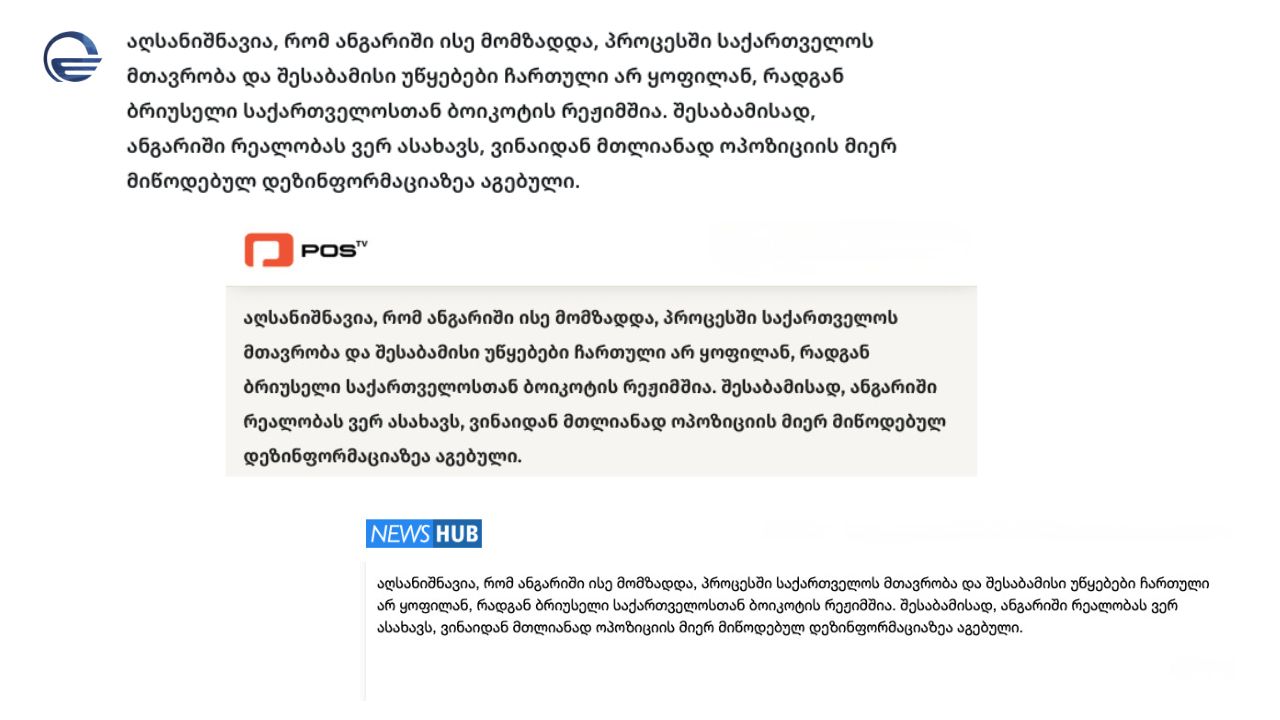
“The report was prepared without the involvement of the Georgian government or relevant agencies, as Brussels is boycotting Georgia. Consequently, the report does not reflect reality, since it is based entirely on disinformation supplied by the opposition,” pro-government media outlets such as Imedi, POSTV, Newshub, ongo.ge and others reported in unison.
Levan Makashvili, Chair of Parliament’s European Integration Committee, who is well aware of how EU institutions operate, claimed that the report had been prepared unilaterally, with “no communication with Georgia, no communication with ministries, no communication with experts”.
“This is a report written unilaterally by five or six people from Brussels, looking out of their windows and writing from their offices,” Makashvili said.
According to Shalva Papuashvili, “Brussels has declared a boycott of Georgia, and it is impossible to prepare such a report without cooperating with the Georgian authorities, obtaining information and verifying it”.
In reality, however, as Georgia’s Ministry of Foreign Affairs itself acknowledges, the European Commission’s report assesses progress made over the course of the year based on information submitted by candidate countries.
The Foreign Ministry also identifies the dialogue formats established under the Association Agreement as another mechanism for assessing progress. It expresses regret that, during the reporting period, the EU side once again failed to hold any of the meetings envisaged by the Association Agreement, at any level, citing the suspension of dialogue with the Georgian side following the European Council conclusions of 27 June 2024. According to the Ministry, this “significantly limits the European Commission’s ability to assess progress objectively”.
“The theory that we have no communication and no contacts with the government is simply not true. The Enlargement Report is a very heavy work the result of 60 colleagues here working in the EU Delegation and hundreds of colleagues working in Brussels, who are following all the developments very closely.
We have consulted all stakeholders. But, the most important input – the Enlargement Report came from the Georgian authorities. We received two inputs: the first one on the 27th of April, the second on the 7th of September. All together – colleagues just informed me – over 530 pages of very detailed information. All this information has been assessed and this is a result in front of you – 90 pages of enlargement report,” said Pavel Herczynski, the EU Ambassador to Georgia.
The Enlargement Report, which covers the period from 1 September 2025 to 1 September 2026, states that it draws on information from various sources, including material submitted by the Georgian government and EU Member States, European Parliament reports, as well as data from various international and non-governmental organisations.
The report also incorporates comparative assessments and indices prepared by other stakeholders, particularly in the field of the rule of law.
“Appointing judges from abroad”
According to Georgian Dream, the EU is demanding that judges be appointed from abroad.
“When they talk about judges being appointed in Georgia from outside the country, this directly confirms what we have been saying all along: European bureaucracy fails to understand the importance of the rule of law, democracy and constitutionalism, and therefore comes up with such proposals, which are simply disgraceful,” Irakli Kobakhidze said.
“As long as I am a member of Parliament and Speaker of Parliament, I will not allow Georgia’s Constitution to be violated or a foreigner to appoint a judge in this country. Period,” Shalva Papuashvili said.
In fact, the Enlargement Report does not call for judges to be appointed by foreigners. Rather, it refers to so-called vetting — a mechanism for assessing the integrity of judges appointed to senior positions, not all judges. The European Commission has been recommending such a mechanism for years, including in relation to other candidate countries, such as Ukraine and Moldova.
In other words, the EU is calling for integrity checks and financial scrutiny of judges holding senior positions in the judiciary, not seeking the authority to appoint anyone to a judicial post.
According to the Commission’s recommendation, Georgia should launch a more comprehensive reform of its judicial system next year. Specifically, it should reform the High Council of Justice in line with the recommendations of the Venice Commission, including addressing the issue of reappointing its members and introducing restrictions on reappointment by establishing fixed, non-renewable terms of office.
It should also establish an extraordinary integrity vetting mechanism involving international experts, who would play a decisive role in the process. The checks should apply both to candidates and to those currently holding all key positions within the judicial system, namely members of the High Council of Justice, Supreme Court judges and chairpersons of common courts.
Although the European Commission does not explicitly use the term vetting, legal experts say that the wording effectively calls on the authorities to introduce precisely such a mechanism. This would involve reassessing judges’ integrity, including by scrutinising their financial assets, examining possible nepotistic connections and conducting other checks.
The leadership of the judiciary, incumbent judges — with a few exceptions — and Georgian Dream all oppose the introduction of an integrity assessment mechanism involving foreign experts, describing it as unacceptable interference in the country’s internal affairs.
However, there are judges who are not opposed to undergoing such checks, including with the participation of foreign experts.
It is worth noting that, after coming to power, Georgian Dream actively cooperated with Thomas Hammarberg, the EU Special Adviser to the Georgian Government on Constitutional and Legal Reform and Human Rights. However, Hammarberg did not have any “decisive role” in the country’s legal reforms.
“Should we release someone who threw a Molotov cocktail?”
The European Commission is calling on the Georgian authorities to “release all persons arbitrarily detained, including politicians, journalists and activists”.
Georgian Dream interprets this as a demand to release people who threw Molotov cocktails and as an attempt to encourage violence.
“What exactly are they asking us to do — release someone who threw a Molotov cocktail or someone who insulted a police officer? They cannot give us any names because they have none. In that case, it would mean openly endorsing violence and the throwing of Molotov cocktails, which is something they do not want to do. They prefer to speak in general terms, but that will not work. Let them have the decency to provide the names of those they want released,” Irakli Kobakhidze said.
It is true that the report does not include a named list of people who should be released.
EU Ambassador Pavel Herczynski said that he could not go into detail, but that various human rights organisations had submitted different lists. He stressed that the decision ultimately rests with the Georgian courts, while emphasising that the EU wants people who have been unfairly handed disproportionate sentences to be released as soon as possible.
Two people are currently in detention on charges of throwing Molotov cocktails at police officers: Davit Lomidze and Temur Zasokashvili. Dozens of other prisoners are serving sentences in cases where the only evidence presented against them consists of police officers’ testimonies.
Elene Khoshtaria, whose health is in a serious condition, is in prison for writing an inscription on a banner. According to the EU’s assessment, this is a clear example of a disproportionate punishment.
Journalists and activists are being arrested for standing on pavements and exercising their freedom of expression on social media. These arrests are also selective, as representatives of Georgian Dream have never been fined for “indecency”.
“The European Union does not support violence, looting, vandalism, throwing Molotov cocktails – in Georgia or anywhere else. .. Claims to the contrary are simply part of a smear campaign against the European Union, and in this deplorable situation in which we are here today with Georgia’s accession de facto halted is also part of this smear campaign. My plea is to Georgian politicians, but also to Georgian journalists, who also have responsibilities: do not take part in this anti-European rhetoric,” Herczynski said.
Ending the disinformation campaign against the European Union is one of the recommendations in the European Commission’s Enlargement Report.
Georgia remains an EU candidate country in name only and is at risk of losing its visa-free travel regime. This is the European Commission’s main conclusion regarding Georgia in its 2026 Enlargement Report.
According to the European Commission’s assessment, the ruling Georgian Dream party continues to undermine the country’s path towards EU membership by attacking democratic principles, the rule of law and fundamental rights, while further facilitating state capture.