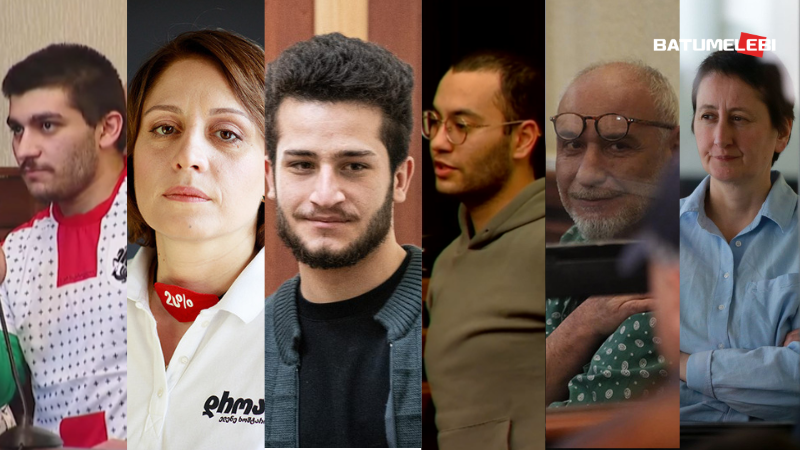
Transparency International – Georgia has published an updated list of political prisoners, according to which the number of political prisoners in Georgia currently stands at 90.
According to the organisation, the list was compiled based on the criteria established by a resolution of the Parliamentary Assembly of the Council of Europe (PACE). Under these criteria, a person may be considered a political prisoner if their deprivation of liberty is connected to:
» a violation of fundamental rights
» detention for political reasons, where the alleged act has no connection to a criminal offence
» a clearly disproportionate punishment
» discriminatory treatment
» the outcome of proceedings that are incompatible with the requirements of a fair trial
“There were more [people on the list], but, as you know, plea agreements were reached with some of them. Today, the number stands at 90. This is not simply a list of individuals who are considered political prisoners. There is a resolution of the Parliamentary Assembly of the Council of Europe that defines the concept of a political prisoner and establishes certain criteria. There are five such criteria, and if even one of them is met, a person may be considered a political prisoner. The overwhelming majority of these 90 individuals meet more than one criterion. Many of them meet all five criteria,” said Alesandre Baramidze.
The list begins with Mzia Amaglobeli and Elene Khoshtaria. All individuals included in the table, except for two, were punished in connection with exercising their rights to freedom of assembly and expression. The exceptions are former businessmen Giorgi Chikvaidze and Irakli Papiashvili, who had close ties with Georgian Dream.
According to the report, they were “punished because of a conflict with the Prosecutor’s Office and because they allegedly refused to assist a sanctioned Russian oligarch, at the request of Georgian Dream, in hiding his yacht in Georgia’s territorial waters.”
According to Transparency International – Georgia, another potential candidate for inclusion on the list is politician Aleksandre Elisashvili, who was recently sentenced to 13 years in prison.
“At this stage, Elisashvili has not been included on this list because he has been convicted of an attempted arson committed with a terrorist motive. The defence categorically rejects that his actions were motivated by any terrorist intent. However, at this moment it is impossible to assess whether the court sufficiently substantiated its conclusion that Elisashvili acted with a ‘terrorist motive’, as the reasoned judgment has not yet been published. If it is established that the court unjustifiably reclassified the act and attributed a terrorist motive to Elisashvili — despite the absence of such intent — in order to impose a harsher sentence, there would be grounds for including him on this list as well,” Transparency International – Georgia said in its explanation.
Former President Mikheil Saakashvili is also not included on the political prisoners’ list.
“We compiled the list based on the case materials available to us. With the exception of two cases, the materials mainly concern individuals who were detained, charged and convicted in connection with protests. At present, court proceedings are actively ongoing against eight political leaders, and in the near future, we will likely see convictions issued against these eight political leaders as well. Saakashvili is among them, and if such convictions are handed down, we will add those eight individuals to the list. As for the older cases, we have not studied the materials related to his previous cases,” Aleksandre Baramidze told Netgazeti.
Asked why Saakashvili’s case had not been studied, given that Chikvaidze and Papiashvili — whose cases were also unrelated to protests — had been included on the list, Baramidze responded:
“There are two cases that are also unrelated to protests, but in those cases the interest and political motivation of the Prosecutor’s Office are so obvious and visible that we included these two individuals on the list as well. Regarding Saakashvili’s case, as I have already mentioned, we have not studied the materials of his previous cases, while we had studied the case materials of those two individuals, and we have an absolutely solid basis to state that they are also political prisoners. Someone may not be included [on the list], but that does not mean they cannot be a political prisoner. We simply base our work only on the materials we have examined ourselves. These materials concerned the protests and the problems that have emerged over the past two years, including the protests.”
The full list of political prisoners and the criteria can be found in the attached file.