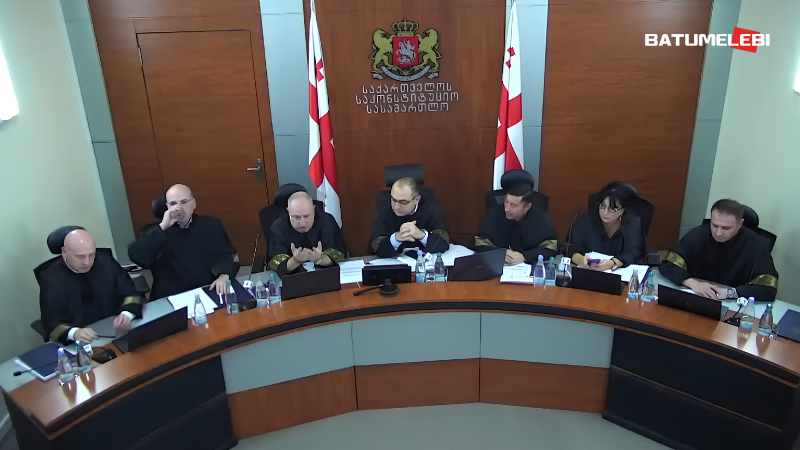
The case has drawn criticism from Georgian civil society and European officials, while opposition representatives challenge the evidence and legal grounds for the proposed bans.
Georgia’s Constitutional Court began hearings on 21 October 2026 on a constitutional complaint brought by 88 MPs from the ruling Georgian Dream party seeking to declare five major opposition parties unconstitutional and ban their activities. The proceedings, taking place in Batumi, have sparked concerns about political pluralism, judicial independence and the country’s democratic future.
The case is also raising questions about how Georgia officially interprets the 2008 Russia-Georgia war and whether the arguments advanced by the ruling party could have implications for the country’s sovereignty and territorial integrity.
What is Georgian Dream seeking to ban?
The complaint targets five political groups: United National Movement; Coalition for Change, which includes politicians associated with Nika Gvaramia, Nika Melia, Girchi and Droa; Strong Georgia–Lelo; the Federalist Party; and For Georgia, founded by former prime minister Giorgi Gakharia.
The case is based partly on allegations concerning the actions of the United National Movement, which governed Georgia from 2004 to 2012, including its handling of the August 2008 war with Russia. The complaint refers to a report by a parliamentary investigative commission led by Tea Tsulukiani, a former justice minister and senior Georgian Dream politician.
The complaint argues that actions by the former government contributed to the occupation of Georgian territories and strengthened Russia’s position concerning those territories. It presents these allegations as grounds for declaring the targeted parties’ activities unconstitutional.
The potential consequences, however, extend beyond the fate of the five parties, according to critics. Constitutional law experts have warned that accepting the complaint’s interpretation of the 2008 war could undermine Georgia’s longstanding position on Russian aggression and complicate future efforts to restore the country’s territorial integrity.
Civil society challenges the legal grounds
Opposition to the proposed bans had emerged before the hearings began. On 16 October, the Georgian Young Lawyers’ Association (GYLA) submitted an amicus curiae opinion to the Constitutional Court, arguing that the purpose of banning opposition parties was not to protect the democratic constitutional order, but to eliminate political competition and preserve the ruling party’s power.
Transparency International Georgia also published an analysis challenging the arguments in the lawsuit, questioning the grounds for banning the five parties.
On 19 October, the organisation warned that the case concerned a much broader section of the opposition than its formal scope might suggest. Constitutional law specialists also raised concerns that the court’s decision could affect Georgia’s sovereignty and its ability to pursue the restoration of its territorial integrity.
On 21 October, the first day of hearings, representatives of Coalition for Change asked the court to exclude the so-called “Tsulukiani’s commission’s” report from the evidence. Nika Gvaramia, one of the coalition’s leaders, argued that the report was politically motivated and lacked the necessary evidentiary basis. He also questioned whether material produced by the commission, including its findings and witness statements, could legitimately be treated as evidence in the case.
The court rejected the request to remove the report from the evidence. Presiding judge Revaz Nadaraia clarified, however, that this did not mean the court would automatically accept the report’s contents and assessments as established facts.
The 2008 war becomes a central point of dispute
The hearings have focused particularly on the complaint’s interpretation of the August 2008 war, when Russia invaded Georgia and occupied parts of its territory.
Former Georgian Dream MP Dimitri Tskitishvili argued that the lawsuit’s interpretation could effectively provide Russia with a legal argument to support its position on the war. He warned that adopting the ruling party’s claims could imply that Georgia’s own actions had provoked Russia’s military intervention, rather than recognising Russia’s responsibility as the aggressor and occupying power.
On 22 October, Gvaramia asked the court to obtain documents from Georgian state institutions concerning the country’s position on the war in international proceedings. These included materials submitted to the prosecutor of the International Criminal Court between 2008 and 2022, as well as records of Georgia’s positions in international legal proceedings and the Geneva International Discussions.
Gvaramia argued that the court needed to establish whether the Tsulukiani commission’s conclusions contradicted positions previously maintained by the Georgian state. If the state had presented a different account of the war internationally, he argued, the commission’s interpretation could not simply be treated as an established fact.
He also requested that witnesses from state institutions be summoned and questioned. The court rejected these requests.
Meanwhile, another dispute emerged over the complaint’s clarity. Constitutional Court judge Eva Gotsiridze repeatedly asked Georgian Dream’s representatives to specify which allegations applied to each of the five parties. Opposition representatives argued that the complaint’s did not clearly distinguish the alleged actions of individual parties, raising concerns about their ability to defend themselves effectively.
International criticism mounts
The proceedings have prompted criticism from European officials, who have warned that banning opposition parties could undermine democratic pluralism.
On 19 October, European Commission spokesperson Christian Wigand said the EU was closely monitoring the case. He warned that the proceedings, alongside recent legislative changes and earlier statements about banning opposition parties, pointed to the troubling instrumentalisation of the justice system and threatened fundamental freedoms, democratic pluralism and fair political competition.
On 20 October, Council of Europe Secretary General Alain Berset called on Georgian Dream to protect political pluralism and preserve space for political opposition. He stressed that political pluralism was essential to a healthy democracy and central to Georgia’s obligations as a member of the Council of Europe.
Germany also expressed concern. On 21 October, German Foreign Ministry spokesperson Kathrin Deschauer said the case was another step in a broader trend that was weakening domestic democracy and moving Georgia further away from the European Union. She said Germany would convey its concerns and questions to the Georgian side.
On 22 October, Gudrun Kugler, Vice-President of the OSCE Parliamentary Assembly, called on Georgian Dream to withdraw the lawsuit and end what she described as politically motivated legal proceedings. She argued that political competition should be decided at the ballot box and through open democratic debate, rather than through court cases initiated by the governing majority to eliminate political rivals.
Court access and the political stakes
The hearings have also raised concerns about transparency. On 21 October, Batumelebi reported that many journalists from independent media outlets were not allowed into the courtroom, while only Georgia’s public broadcaster was permitted to film the proceedings. The Constitutional Court said the hearings would be streamed on its YouTube channel, but other media organisations were not allowed to record inside the courtroom.
The same day, 19 Georgian civil society organisations issued a joint statement describing the proceedings as a new and particularly serious stage in the country’s democratic backsliding. They argued that the proposed bans represented a continuation of the ruling party’s repressive policies and warned that the case could formalise one-party rule.
The hearings are scheduled to continue through 23 October. As the court considers the lawsuit, the central question is not only whether five opposition parties will be allowed to continue operating, but also how far the ruling party can go in using constitutional proceedings against its political opponents—and what the outcome could mean for Georgia’s political pluralism, democratic institutions and future.